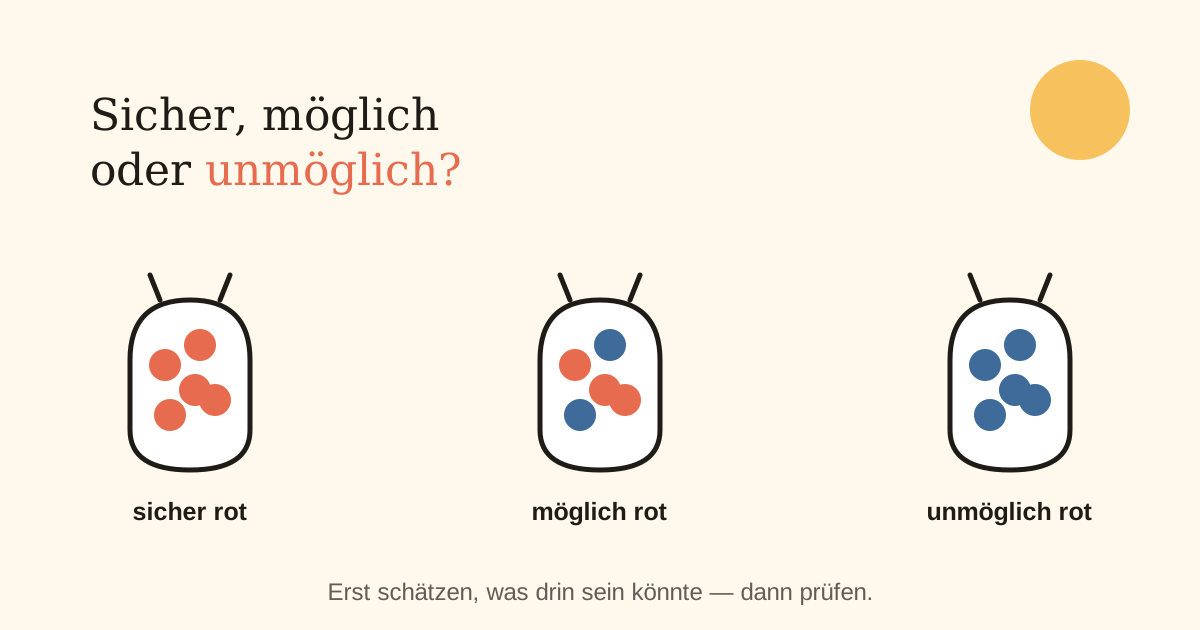
Will it rain tomorrow? Will the coin land on heads or tails? Will you pull a red or a blue marble out of the bag? Children run into questions like these every day, long before the word "probability" ever comes up in maths class. That's why, in primary school, the topic doesn't start with percentages or fractions — it starts with three simple words that roughly sort out chance: certain, possible, impossible.
That sorting isn't a side note — it's one of the five major strands of primary maths teaching, ranked alongside numbers, measurement and geometry. A child who learns early to put chance into words finds it much easier later to understand why a weather forecast says "60% chance of rain" instead of simply predicting "it will rain" or "it won't".
The three basic ideas: certain, possible, impossible
It all starts with a simple test: what can actually happen in a chance event?
- Certain: a bag holds only red marbles — reach in, and you're guaranteed to pull out a red one.
- Possible: a bag holds red and blue marbles — pulling out a red one can happen, but doesn't have to.
- Impossible: a bag holds only blue marbles — pulling out a red one can never happen.
More likely or less likely
The next step compares two possible events without putting a percentage on either: if a bag holds four red marbles and one blue one, pulling out a red one is more likely than pulling out a blue one — simply because there are more red marbles inside. Comparing by eye like this, "more means more likely", is exactly the stepping stone to percentage-based probability later on, without a single percentage figure needing to appear yet.
The most common misconception
After five dice rolls with no six, plenty of kids — and not only kids — start thinking a six is now "due". That's a fallacy: a die has no memory. Every roll is a new, independent event with exactly the same one-in-six chance, no matter what happened on the rolls before it.
The bag of marbles makes this point clearer than the die does: as long as no marble is removed and left out, the colours still inside never change — so the probability stays exactly the same on every single reach into the bag.
What your child can already build on
Your child already knows tally charts from working with diagrams — that same tool is perfect for counting, while rolling a die, how often each number actually comes up, and comparing the result with the prediction. And the bigger/smaller comparisons your child already knows from numbers are exactly the kind of thinking needed to compare two probabilities, too.
How to practise this at home in 10 minutes
A few drills that need no worksheet:
- Before every dice roll, have your child guess: "do you think it'll be an odd or an even number?" — then check together.
- Fill a bag or cup with different numbers of red and blue objects and have your child predict beforehand which colour is more likely to come out.
- Keep a tally of 20 coin flips and count at the end: does heads come up roughly as often as tails?
- When the weather forecast comes on, talk through together what "60% chance of rain" actually means — more likely than not, but not a sure thing.
What Talentists does differently
Our worksheets introduce probability through bags, dice and tally charts long before a single percentage ever shows up — building a solid feel for chance that percentage-based probability in later years can build directly on.