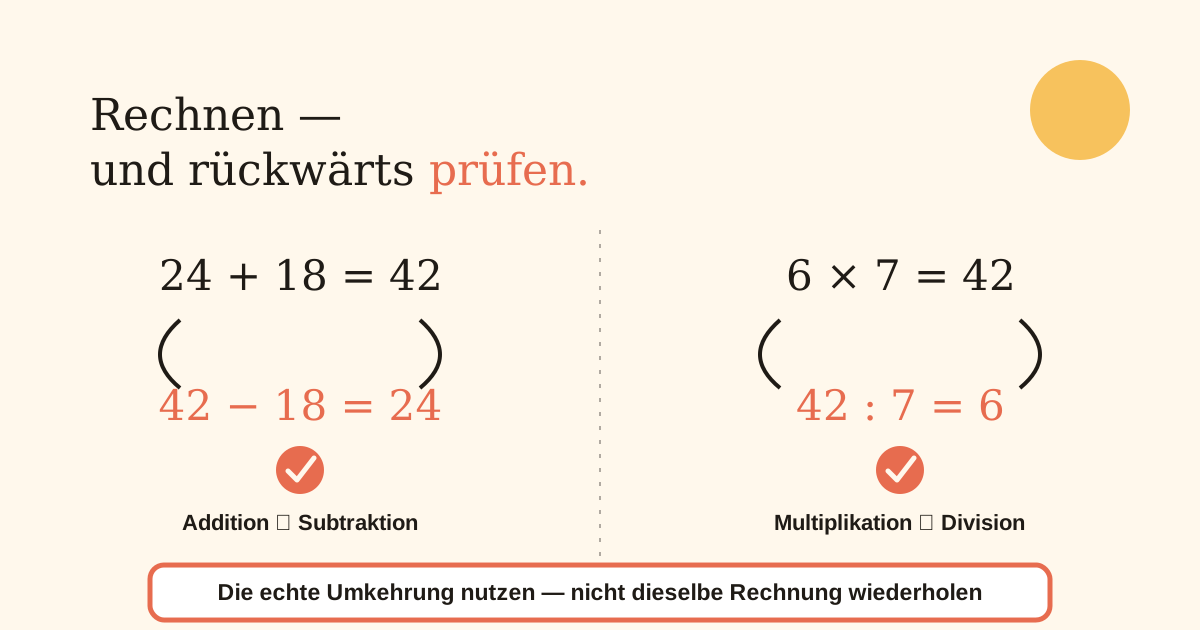
Once a calculation is done, many kids consider the job finished — but the answer itself already holds a way to check it. Every basic operation has an inverse: what was added can be subtracted, what was multiplied can be divided. That inverse is what checking your work really is, and it's more than a tedious formality tacked onto the edge of a worksheet.
The real payoff isn't the checking itself, but what practising the inverse reveals about numbers: a child who truly understands 24 + 18 = 42 also automatically knows that 42 − 18 = 24 and 42 − 24 = 18 — three facts from one single number relationship, instead of three separately memorised facts.
Checking addition and subtraction
An addition is checked by subtracting one of the two addends from the result and expecting to land on the other addend: for 24 + 18 = 42, working out 42 − 18 gives 24 again — if that checks out, the addition was correct. The same works the other way for subtraction: 42 − 18 = 24 can be checked by adding 24 + 18 and arriving back at 42.
Checking multiplication and division
Multiplication and division work the same way, just using the other pair of operations: 6 × 7 = 42 is checked by working out 42 : 7 and landing back on 6, or 42 : 6 and landing back on 7. And a division like 42 : 6 = 7 can be checked by working backwards with 7 × 6.
The most common mistake
Checking your work completely misses the point if a child simply repeats the exact same calculation the exact same way instead of using the inverse operation. Re-adding 24 + 18 to check 24 + 18 = 42 repeats any mistake exactly — and ends up confirming it.
Only the genuine inverse — subtraction instead of addition, division instead of multiplication — reliably catches an error, because it arrives back at the starting value by a different route.
What your child can already build on
A child who's solid on crossing ten already knows number relationships like 8 + 5 = 13 as a web of several connected facts, not as isolated ones — and that's exactly the kind of thinking checking your work needs. The times tables already carry the same inverse built in: knowing 7 × 6 = 42 automatically means knowing 42 : 6 = 7 too.
How to practise this at home in 10 minutes
A few drills that need no worksheet:
- After every solved problem, ask "how could you check that the other way round?" — not "do it again", but "do the inverse".
- From one number relationship like 6, 7 and 42, write out all four possible facts together: 6 × 7 = 42, 7 × 6 = 42, 42 : 6 = 7, 42 : 7 = 6.
- Give your child a deliberately wrong calculation and have them use the inverse to find the mistake.
- While shopping: when your child works out the change, have them check with the inverse — that the price plus the change adds back up to what was paid.
What Talentists does differently
Our worksheets ask the inverse question deliberately after every problem instead of just handing over an answer key — so checking your work becomes your child's own habit, not a step only a teacher ever asks for.