A city map fits in a jacket pocket even though the city itself stretches for miles. A model train is tiny even though the real thing weighs tonnes. Scale is what makes that possible: a fixed rule for how much real-world size fits into a single centimetre of paper or model. Once your child can read that rule and apply it, a map or floor plan turns into a calculation that can be solved reliably.
Scale usually sits quietly in a corner as a ratio, something like 1 : 100 or 1 : 25,000. The first number always stands for the paper, the second for reality — and translating between those two roles is the whole trick.
What scale means
1 : 100 means 1 cm on paper equals 100 cm, or 1 m, in reality. A floor plan at this scale shows a 4 m wall as a 4 cm line — reality has been shrunk down exactly a hundredfold. The bigger the second number in the ratio, the bigger the shrink: 1 : 25,000 on a hiking map shrinks far more than 1 : 100 on a floor plan, because a whole landscape needs to fit on the page instead of just one room.
Going from paper to reality
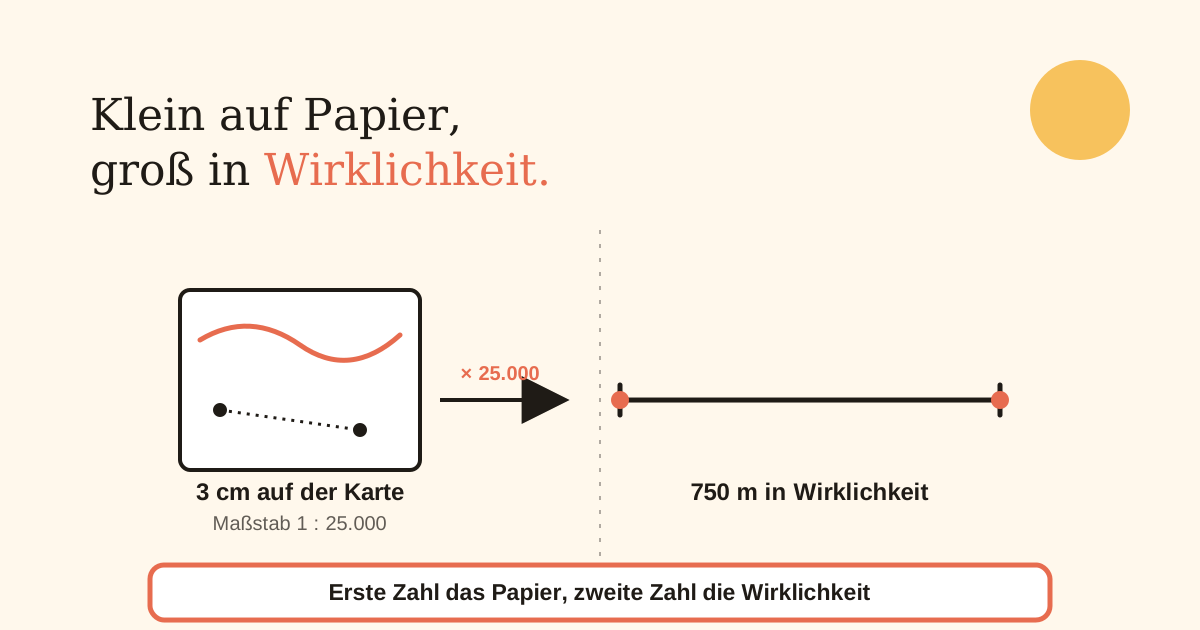
To turn a measured length on a map into a real-world distance, multiply by the second number in the scale. On a hiking map at 1 : 25,000, your child measures 3 cm between two towns with a ruler: 3 × 25,000 = 75,000 cm, which is 750 m in reality.
Going from reality to paper
The reverse direction needs division: a real-world length is divided by the second number in the scale to find the length on paper. A room is 5 m long and needs to be drawn at 1 : 100: 500 cm ÷ 100 = a 5 cm line on the floor plan.
The most common mistake
Mixing up the direction — multiplying instead of dividing, or the other way round — throws the answer off by a huge factor without it being obvious at first glance. A useful rule of thumb: going from small paper to big reality, the number grows, so multiply. Going back, from big reality to small paper, the number shrinks, so divide.
The second trap is units: scale calculations run in centimetres, but distances are usually given in metres. Before calculating, it's always worth checking whether metres need converting into centimetres first.
What your child can already build on
A child who's confident converting units already knows that a factor of 100 sits between metres and centimetres — exactly the knowledge scale needs, just with one extra shrinking step layered on top. And a child who already measures lengths reliably with a ruler brings the one practical skill that makes a map readable in the first place.
How to practise this at home in 10 minutes
A few drills that need no worksheet:
- Measure your child's own room and draw it as a floor plan at 1 : 50 on paper — bed, door and window included.
- Find two known places on a city map or hiking map, measure the distance with a ruler, and work out the real-world distance.
- Build a model out of building blocks or Lego at an agreed scale, such as "one block equals one metre".
- Find the stated scale on a globe or world map and talk through together why it has to be such a huge number.
What Talentists does differently
Our worksheets have your child calculate scale in both directions — from paper to reality and back — instead of only ever asking one direction, so they genuinely understand what the two numbers in the ratio mean instead of memorising a single calculation direction.