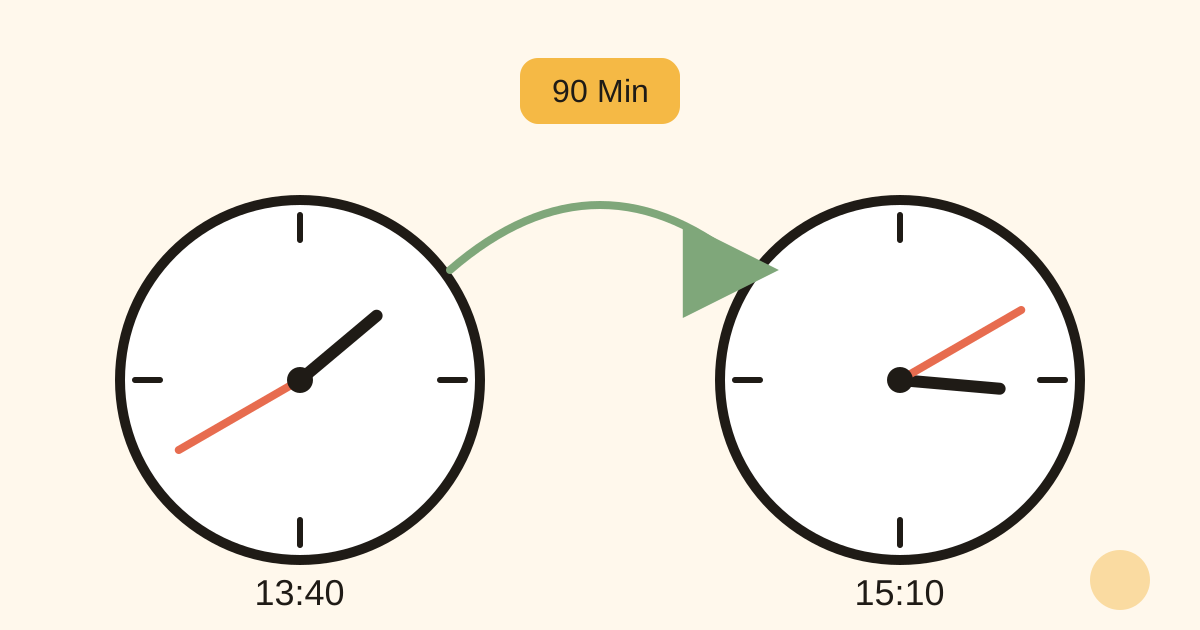
Your child can read a clock — 1:40pm and 3:10pm are no problem. And yet that same skill often stumbles on a different question: how much time actually lies between them? Reading a clock and calculating with clock times are two different abilities, and the second one arrives at school only once the first is thoroughly solid.
The reason time spans produce so many mistakes is uncomfortable but simple: clock times don't run on base ten. After 59 minutes comes not 60 but a new hour. That break with familiar logic is exactly what makes time spans their own topic — not a variant of ordinary subtraction.
Why ordinary subtraction leads you astray here
The obvious first instinct is to subtract hours and minutes separately, the way you would tens and ones: 3:40pm minus 1:40pm quickly becomes “hours: 15 minus 13 = 2, minutes: 40 minus 40 = 0” — which happens to work. For 3:10pm minus 1:40pm it stops working: minutes 10 minus 40 gives a negative number, and many children don't know where to put it.
That's not carelessness — it's a very logical mistake: it carries over a rule (subtract column by column) that works perfectly for base-ten numbers into a system with 60, not 10, units per step. Without a deliberate intermediate strategy, that goes wrong.
The number line for clock times: via the full hour
The most reliable strategy carries over exactly the trick your child already knows from crossing ten: first to the next round number — here, the next full hour — then onward. Played out for 1:40pm to 3:10pm: first from 1:40 to 2:00 — that's 20 minutes. Then from 2:00 to 3:00 — a full hour. Then from 3:00 to 3:10 — another 10 minutes. Together: 20 + 60 + 10 = 90 minutes, so an hour and a half.
An empty number line on paper makes this visible: a line with three hops, each one labelled. The picture replaces the abstract rule — and works for any time span, however awkward the clock times.
When the time span crosses midnight
One special case confuses especially often: how long is it from 10:30pm to 6:15am? The same method helps here too, with one extra intermediate step across midnight: 10:30pm to midnight is 90 minutes, then midnight to 6:15am is another 6 hours 15 minutes. Together, 7 hours 45 minutes. The trick stays the same — only the number of hops grows.
Practising time spans day to day
Time spans can be trained on the side, no worksheet needed:
- The bedtime check: “It's 7:30pm now, bedtime is 8:00pm — how many minutes are left?”
- The kitchen timer: while cooking pasta, read the start and end time and have your child work out the duration themselves before the timer beeps.
- The timetable: “The train leaves at 9:47 and arrives at 11:15 — how long is the journey?” Real timetables give awkward, realistic numbers.
Time spans are one of those topics where short, concrete practice gets there faster than any explanation in passing. Once the number-line trick has sunk in, your child can work out any duration — a school lesson, a train ride, a wait — with the same reliable method.