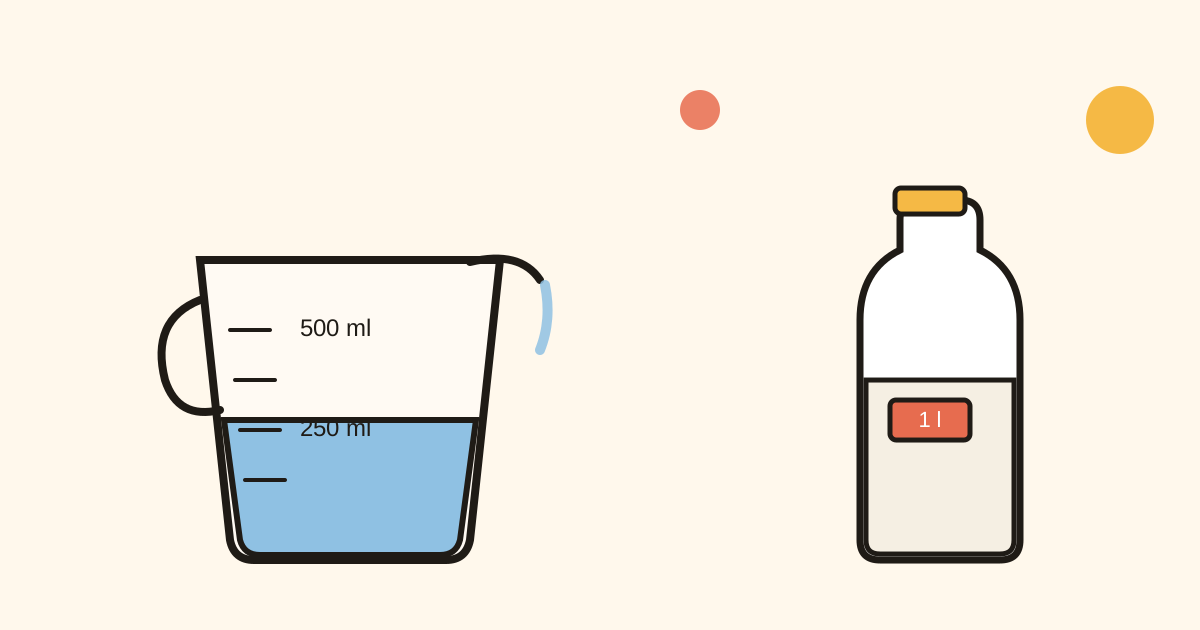
After length and weight, capacity — what the curriculum calls Hohlmaße — is the third big measurement topic in grade 2/3. How much fits in a bottle, a bucket, a bathtub? The same pattern applies: the units themselves are learned quickly — what's harder is the feel for whether something is more likely millilitres or litres.
And once again, a device sitting in almost every kitchen, rarely seen as a learning tool, earns its keep: the measuring cup. It shows instantly and without argument how much is really in a container.
Pour first, measure second
As with length and weight, the curriculum's order pays off at home too: start with direct comparison by eye and hand. Put two containers side by side and guess which holds more — a drinking glass and a teapot, a yoghurt pot and a milk bottle. No number yet, just a judgement.
Only after that does the measuring cup come in, and with it millilitres and litres. What matters: the child should pour and read the markings themselves, not just watch. The measuring cup turns an abstract unit into a tool you hold in your hand.
ml or l? The anchor trick
Here too, the question isn't solved by memorising a rule but by a handful of fixed reference volumes: a teaspoon holds about 5 millilitres, a drinking glass around 200 millilitres, a milk bottle or carton exactly 1 litre, a bucket about 10 litres, a full bathtub around 150 litres.
Anyone who knows a drinking glass holds about 200 millilitres spots instantly that “filling a bathtub with 3 litres” can't be right — before even doing the sum. That gut feeling for scale is the actual learning goal, not the conversion table.
The most common mistake: mixing up litres and millilitres
One misconception shows up often: big means many litres. A large but shallow casserole dish can hold less than a small, tall jug. Volume doesn't depend on outward size alone but on height, width and depth together — counter-examples like these are worth using because they visibly disprove the misconception rather than just naming it.
A second trap waits at writing it down: “1 litre 500 millilitres” often gets written as “1.5 l” or plain “1500” with no unit, when “1.5 l” and “1500 ml” are both correct. As with money and weight, it helps to say it separately first — “one litre and five hundred millilitres” — and derive the written form together afterwards.
Three everyday drills with the measuring cup
Capacity can be practised on the side, no worksheet needed:
- The estimate bet: guess before pouring (“how much do you think fits in the cup?”), then check with the measuring cup and talk through the gap.
- The drink check: count aloud how many millilitres land in the glass while pouring juice or water, and compare with the bottle label.
- The recipe: let your child measure out milk, water or oil themselves while cooking or baking. Recipes give real numbers with a real purpose, not invented practice problems.
Capacity, like length and weight, never leaves the kitchen table — the measuring cup is usually already in the cupboard. Reaching for it regularly hands your child exactly the feel for scale that later makes the difference in word problems involving litres and millilitres.