Up to grade 2, your child solves problems like 37 + 25 in their head, step by step, with crossing ten as the biggest hurdle. Grade 3 adds a new method: column arithmetic, where numbers are written one under the other and worked through digit by digit. For many children this initially feels like a step backwards — suddenly they're asked to practise a method that works differently from the mental math they'd only just mastered.
That's not a contradiction. Stepwise mental math and column arithmetic are two different tools for two different kinds of numbers: small, friendly numbers get solved in the head. Large or unwieldy numbers — 347 + 268, say — get solved in columns, because the method works the same way regardless of how big the numbers are.
Column addition: carrying, step by step
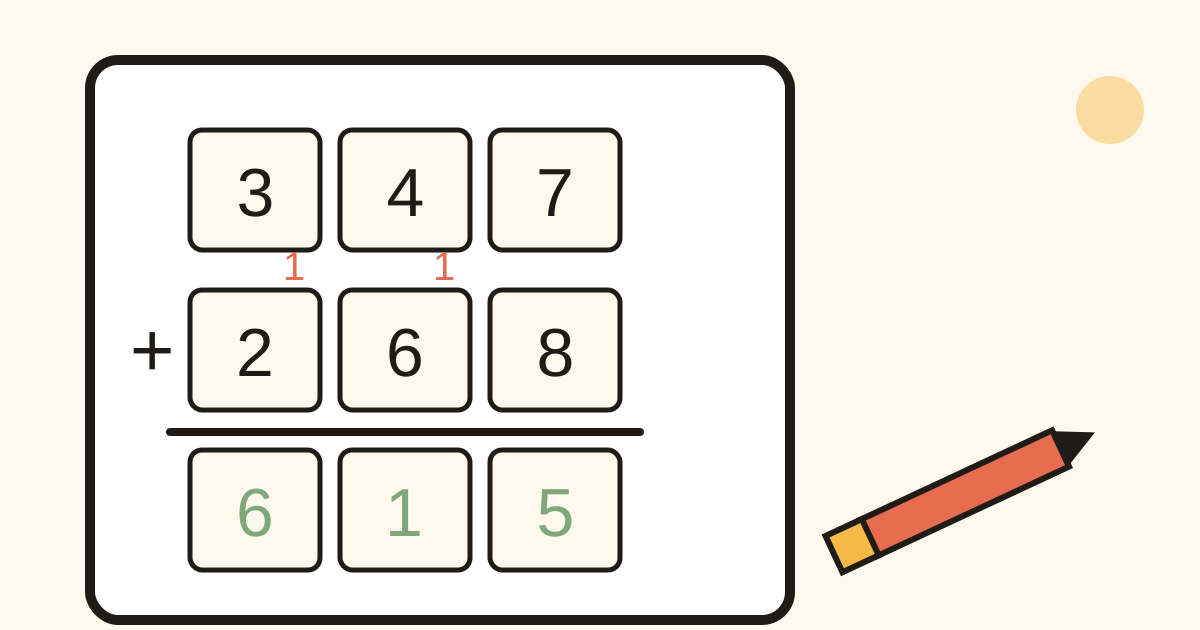
Played out on 347 + 268: the numbers are written one under the other by place value — ones under ones, tens under tens, hundreds under hundreds. You compute from the right, starting with the ones: 7 + 8 = 15. That's more than 9, so the 5 stays, and the 1 “carries” over to the tens.
In the tens column, the carry is added in: 4 + 6 + 1 (the carry) = 11. Again the 1 stays, and again a 1 carries over — this time to the hundreds. Finally, in the hundreds: 3 + 2 + 1 = 6. Result: 615.
So carrying isn't an extra rule — it's the exact same idea as crossing ten in mental math: ten ones become one ten, ten tens become one hundred. The only difference is it isn't held in memory here, but jotted small above the next column — which frees up working memory and makes the step visible.
Column subtraction: decomposing (borrowing)
In subtraction, the counterpart is called decomposing, or borrowing. Take 342 − 178: in the ones column you have 2 − 8, which doesn't work. So one ten is “broken open”: 4 tens and 2 ones become 3 tens and 12 ones. Now 12 − 8 = 4 works.
In the tens column you now have 3 − 7 — which also doesn't work, so one hundred is decomposed: 3 hundreds and 3 tens become 2 hundreds and 13 tens. 13 − 7 = 6. In the hundreds column, 2 − 1 = 1 remains. Result: 164.
Important for parents: there's more than one correct procedure for column subtraction (decomposing, equal additions, borrowing-with-carry), and schools settle on one of them. Don't teach your child the method you learned yourself without first checking the exercise book for which one is being taught — two competing written methods cause just as much confusion here as they do in mental math.
The most common mistake: forgetting the carry
By far the most common mistake in column arithmetic is mundane and stubborn all the same: the carry gets written down but isn't added into the next column. 347 + 268 then becomes 605 instead of 615 — the ones and tens are right, only the forgotten 1 is missing at the end.
The most reliable fix isn't a reminder but a fixed habit: always write the carry small, in the same spot, directly above the column it moves into — not off to the side, not held in the head. What's on the paper can't be forgotten.
When to go to paper, when to stay in the head
One side effect of the new method: some children suddenly want to write out everything in columns, even 23 + 14, where mental math is clearly faster and just as reliable. It's worth steering against that — column arithmetic is a tool for large or unwieldy numbers, not a replacement for mental math on small ones.
A simple rule of thumb for home: if both numbers comfortably fit in the head (roughly up to 100, without many carries), solve it mentally. From three digits, or with several carries in a row, let the paper take over.
At first glance, carrying looks like a new rule to memorise. In fact it's the same crossing-ten your child already knows from grade 2 — just neatly noted in columns instead of held in the head. Once that clicks, the fear of big numbers goes with it.