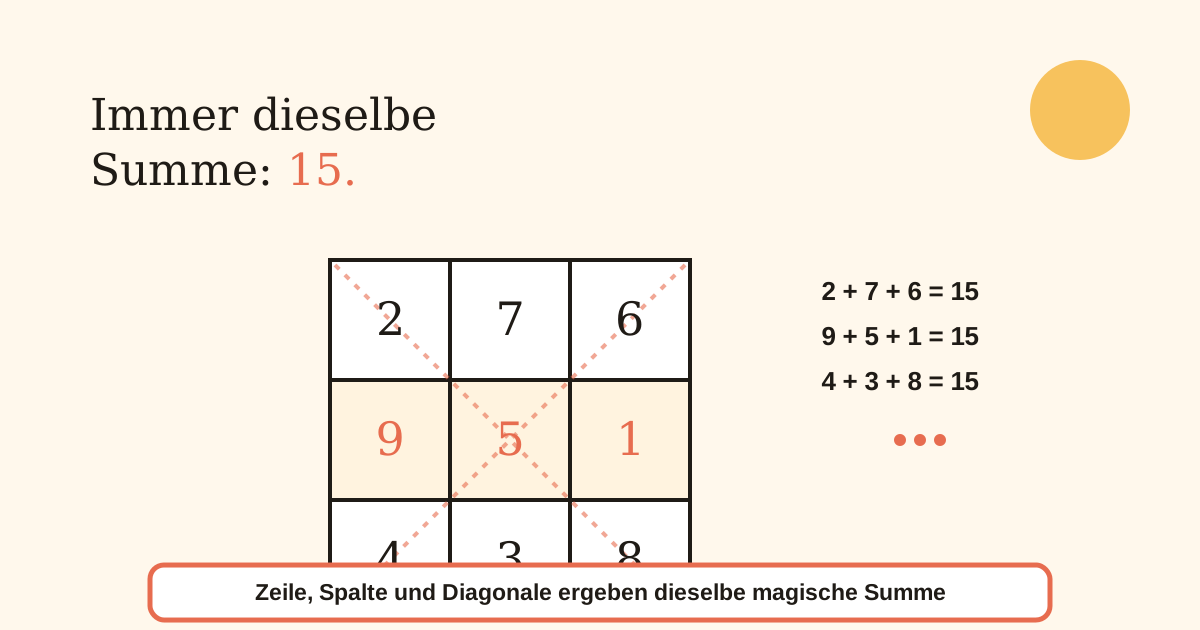
Nine boxes, the numbers 1 to 9, and a promise: whether you add across, down or diagonally, the total is always the same. Magic squares feel like a party trick, and that surprise is exactly what makes them one of the most popular number puzzles in primary school. There's no magic behind them, though — just arithmetic logic that can be cracked systematically.
The appeal for kids is twofold: the puzzle feels like play, but it trains exactly what matters in maths class — mental arithmetic, checking your work, and patient, planned steps instead of wild guessing.
What makes a magic square
A classic magic square is a 3-by-3 grid filled with the numbers 1 to 9, each used exactly once. The condition: each of the three rows, each of the three columns, and both diagonals must add up to the same total — the so-called magic sum. For the numbers 1 to 9, that sum is always 15.
Work out the magic sum first
Before filling in a single box, it pays to think ahead: the sum of all nine numbers from 1 to 9 is 45. Since there are three rows that together contain every number exactly once, each individual row must total a third of that: 45 ÷ 3 = 15. Knowing this number in advance turns the puzzle from "search for something that fits" into "find this one specific number".
Finding missing boxes with the inverse
Once the magic sum is known, every empty box can be filled with a simple subtraction — the same genuine inverse used when checking a calculation: if a row already has 6 and 4, and the magic sum is 15, the missing number is 15 − 6 − 4 = 5. No more guessing, just one calculation per empty box.
The most common mistake
Without the magic sum in mind, kids often try numbers at random: fill one in, add up, change it again — which takes forever and rarely gets there. The second common mistake: only checking rows and columns while forgetting the two diagonals. A square where every row and column works but a diagonal is off is not a finished magic square yet.
What your child can already build on
Fact triangles and number walls already train exactly this kind of thinking: working out a missing box from known neighbouring boxes instead of guessing it. A magic square is essentially a fact triangle with more boxes and one extra condition — the diagonals.
How to practise this at home in 10 minutes
A few drills that need no worksheet:
- Draw a completed magic square using the numbers 1 to 9, erase three or four boxes, and have your child reconstruct it using the magic sum of 15.
- After solving, have your child check every row, column and both diagonals one by one — that's the checking step for a magic square.
- Let your child build their own magic square from scratch, shuffling the numbers 1 to 9 around until every total works out.
- For older primary-school kids: try a 4-by-4 magic square with the numbers 1 to 16 as an extra challenge.
What Talentists does differently
Our worksheets introduce the magic sum explicitly as the first calculation step, instead of treating magic squares as a pure guessing exercise — turning the trick into a strategy your child can reapply to every new puzzle.