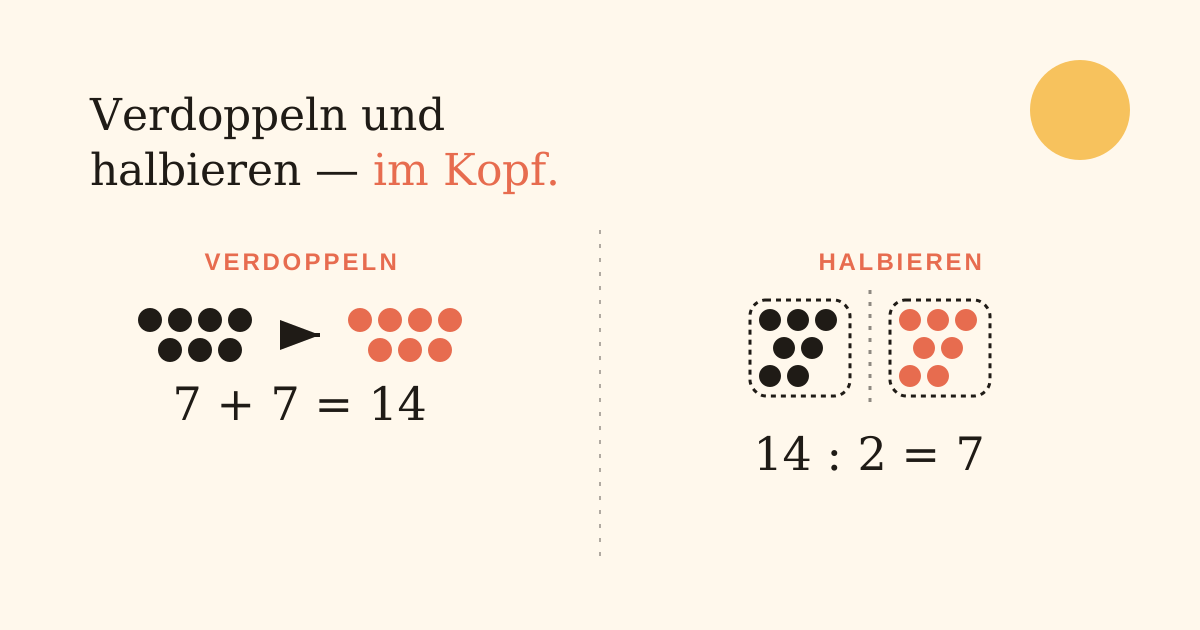
Doubling and halving are among the first calculation strategies children learn in primary school — and among the most-used, because they keep resurfacing everywhere: in the times tables, in splitting sweets between siblings, in fast mental math with bigger numbers. A child who knows 7 + 7 by heart has, almost incidentally, already solved 14 ÷ 2 — both problems describe the same relationship, just read from opposite directions.
Even so, the strategy is often underrated because it looks so simple. But it holds the key to many bigger calculations: a child who can double can also quadruple (double twice) and multiply by eight (double three times) — without ever memorising the bigger times tables by rote. And a child who can halve has a shortcut for any problem with 2 as the divisor, long before written division shows up on the timetable.
The rule in one sentence
Doubling means adding a number to itself. 7 doubled is 7 + 7 = 14. Halving is the reverse: splitting a quantity into two equal parts. 14 halved is 14 ÷ 2 = 7. The two operations are as tightly linked as a question and its answer — knowing one by heart means the other is just reading it backwards.
The real value of the strategy shows once the numbers get bigger. Times 4 is doubling twice: 6 × 4 becomes 6 + 6 = 12, then 12 + 12 = 24. Times 8 is doubling three times. And for addition problems with near-equal numbers like 6 + 7, the near-double helps: 6 + 6 = 12, plus the 1 still missing, makes 13 — faster than counting on.
Where the mistake comes from
Doubling and halving rarely fail on the principle itself — they fail at two very specific spots.
- With two-digit numbers, only one digit often gets doubled: 23 doubled becomes 26 instead of 46, because only the 3 gets doubled while the 2 is simply carried over unchanged. The tens digit needs the same treatment as the ones digit.
- Halving odd numbers like 13 gets guessed rather than calculated — sometimes 6, sometimes 7, whichever feels closer — instead of recognising that 13 = 12 + 1, so only the 12 halves cleanly and the 1 is left over.
- Children mix up "twice as much" with "2 more" in everyday speech, because both phrasings sound similar in casual use. "Twice as many sweets" then turns into +2 instead of ×2 — a language problem, not a maths problem.
- The result doesn't get checked back. A child who halves 28 and gets 12 only notices the mistake by testing: 12 + 12 = 24, not 28 — that check-back rarely becomes a habit on its own.
What your child can already build on
A child who can already count in steps of two (2, 4, 6, 8 …) has already practised the core of doubling — every step of two is a small doubling from one step to the next. Pairing up objects, already central to telling even and odd numbers apart, carries straight over to halving too: an even quantity always splits into two equal piles with nothing left over, an odd one never does.
Everyday situations carry the idea as well: splitting a chocolate bar fairly between two children is halving, so is measuring out two equal portions of dessert. Naming these situations out loud as "halving" links the word to an action the child already masters.
How to practise this at home in 10 minutes
A few drills that need no worksheet:
- A doubling speed round: you call out a number up to 20, your child fires back the double instantly — speed matters more than perfect form here, because automating the fact is the point.
- Split two-digit numbers into tens and ones before doubling: 23 = 20 + 3, then double the 20 (40) and the 3 (6) separately, and only add them together at the end (46).
- Have your child physically split an even number of objects — sweets, building blocks, coins — into two equal piles, then repeat the same problem purely in their head.
- Have every halving checked back immediately: "if 16 halved is 8, what's 8 + 8?" — turning the check-back into a fixed habit rather than an occasional extra.
What Talentists does differently
Our grade 1–2 worksheets don't train doubling and halving in isolation — they're interleaved with what builds on them directly: the times tables and crossing ten. Two-digit problems only appear once the single-digit ones are solid, and every halving problem comes paired with a check-back step, so verification becomes a habit from the start. A five-minute assessment shows exactly where your child stands, and the worksheet starts right there.