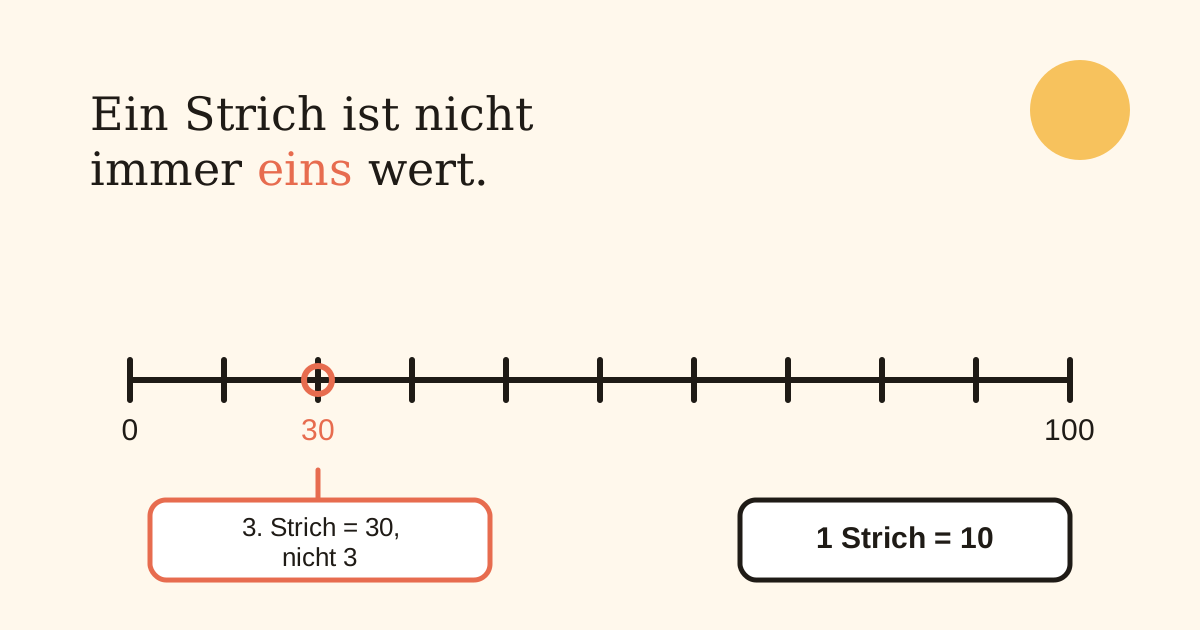
"Where's roughly 30 on this number line?" The line runs from 0 to 100, with ten equal sections marked in between — and plenty of children still point to the third tick from the left, as if every tick stood for the number 1. On a number line from 0 to 10, that would even be correct. But the moment the range changes, so does what a single tick is worth — and that's exactly what many children in grade 2 and 3 miss.
The good news: once the trick clicks, any new number line becomes readable in seconds, no matter how big the numbers get.
The rule in one sentence
Before counting anything, work out what ONE tick is worth: find two labelled numbers, work out the difference between them, and divide by the number of sections in between. If there are exactly ten sections between 0 and 100, each tick is worth 100 ÷ 10 = 10. Only after that does the actual counting or reading make sense.
That one step — figuring out what a single tick is worth before counting — is the entire difference between guessing and reading confidently, whether the line starts at 0 or, as becomes common later, somewhere in the middle.
Where the mistake comes from
Children first meet the number line in the range up to 20, where practically every tick is worth exactly 1. That experience runs so deep that it gets carried over automatically to every later number line — even once the gap suddenly becomes 2, 5, 10, or even 100 per tick.
- On a number line from 0 to 100 in steps of ten, a child still counts in ones, landing far from the target number.
- A number line that doesn't start at 0 (say, from 20 to 30) gets counted from the left edge as if it started at 0.
- If a label is missing in the middle, a child guesses instead of working out the tick value from two known end numbers.
- When rounding on a number line, a child rounds to the nearest mark without first checking what that mark is actually worth.
What your child can already build on
A ruler is a number line your child already uses every day: between the 0 and the 10 sit ten equal centimetre sections, and nobody counts them in millimetres when only whole centimetres are asked for. That exact principle — understand the gap between two known numbers first, then read off the value — is behind every number line.
A fever thermometer or a scale with coarse markings show the same thing: not every tick is worth one; the gap between two labelled numbers decides what a single tick is worth.
How to practise this at home in 10 minutes
A few concrete drills that need no worksheet:
- On a hand-drawn number line with only two labelled end numbers (say, 0 and 50), work out together what one tick is worth before marking a single point.
- Draw the same number line once in steps of ten and once in steps of five, and compare how different the same gap looks.
- On a ruler, point to any number between two centimetre marks and estimate how close it sits to each one.
- Draw a number line that doesn't start at 0 (say, from 40 to 60), and find a given number on it.
What Talentists does differently
Our grade-2 and grade-3 worksheets deliberately train the number line with varying step sizes and starting points, instead of relying on a single steps-of-ten pattern — exactly the variety that shows up in real maths lessons and word problems. A five-minute assessment shows whether your child already works out the value of a tick reliably or still counts in ones by default, and the worksheet starts exactly there. Stuck on one specific problem? A QR code gives a free explanation right next to it, no account needed.