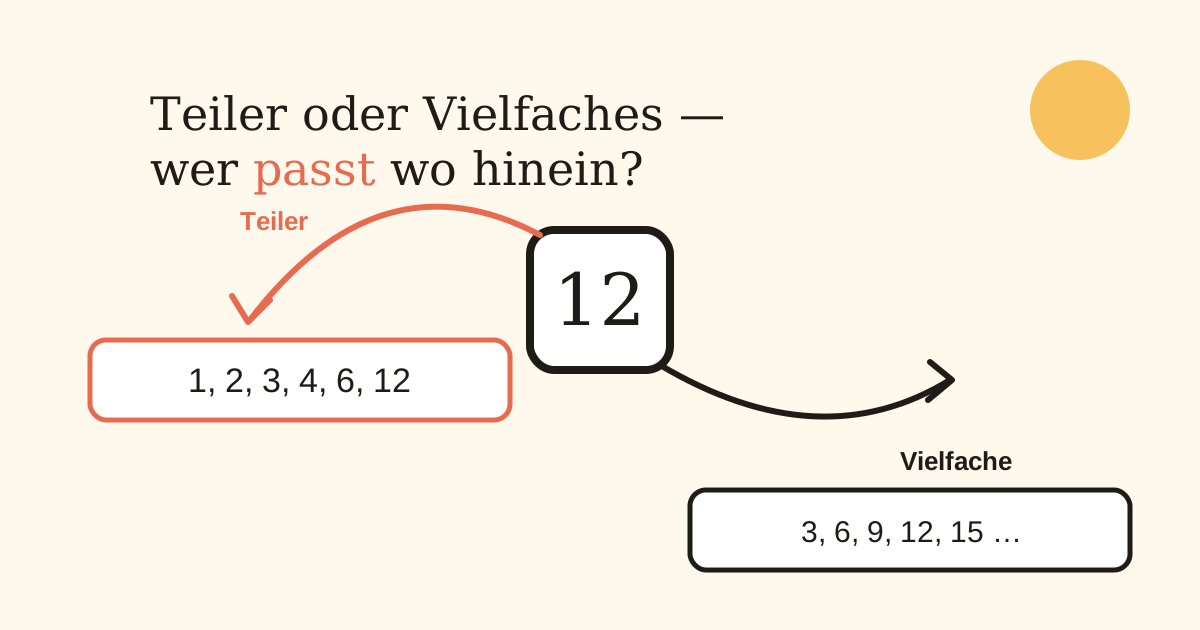
"Name all the factors of 12." — "6, 12, 18, 24…" The answer sounds confident, but it answers a different question: those are multiples of 6, not factors of 12. Once factors and multiples show up in the same chapter around grade 4, plenty of children swap the two terms freely — not because the arithmetic is missing, but because both words describe the same relationship, just viewed from opposite directions.
Once the difference clicks, the mix-up usually clears up for good — the underlying arithmetic is already familiar from the times table.
The difference in one sentence
A factor is a number that divides evenly into another number: 3 is a factor of 12 because 12 ÷ 3 = 4 with nothing left over. A multiple is the result of a multiplication: 12 is a multiple of 3 because 3 × 4 = 12. They're two directions of the same relationship — the question just flips: "what fits inside?" (factor) versus "what comes out?" (multiple).
That's why the factors of a number are always a short, fixed list — 12 has exactly the factors 1, 2, 3, 4, 6, 12. Multiples, on the other hand, go on forever — the multiples of 3 are 3, 6, 9, 12, 15, and so on without end.
Where the mix-up comes from
Both terms come from the same times-table row, so to a child they feel nearly identical. Reciting the 3-times table — 3, 6, 9, 12 — is literally naming multiples of 3. So when asked "is 3 a factor of 12?", the child hears the same numbers 3 and 12 from that same row and answers on instinct, without checking which direction the question is actually asking.
- Asked to "name the factors of 12," a child lists multiples of 12 instead (12, 24, 36…) rather than the numbers that divide into 12.
- Asked "is 4 a multiple of 2?", a child checks whether 4 divides into 2, instead of whether 2 × 2 = 4.
- The bigger and smaller number get swapped: "12 is a factor of 3" instead of the reverse — a factor is never bigger than the number itself (except for 0).
- 1 and the number itself get forgotten as factors, even though every number has at least those two.
What your child can already build on
Sharing fairly makes factors concrete right away: split 12 sweets among some friends — does it work evenly with 2 kids? 3? 5? Any number that leaves nothing left over is a factor of 12. That's exactly the kind of sharing your child already does at the kitchen table, no vocabulary required.
Multiples show up best through skip-counting: counting in threes — 3, 6, 9, 12 — is literally listing multiples of 3. A number line with every third number circled makes it visible: multiples form an endless line, while the factors of a single number stay a short, fixed list.
How to practise this at home in 10 minutes
A few concrete drills that need no worksheet:
- Pick a number like 12 or 18 and find ALL its factors together, writing them out as a complete, closed list.
- On a number line from 1 to 30, circle every multiple of a chosen number (say, 4) and see how the pattern continues.
- Say the test question out loud before calculating: "does it fit inside?" for factors, "what comes out?" for multiples.
- Share real objects (sweets, blocks) fairly and check which group sizes leave nothing left over.
What Talentists does differently
Our grade-4 worksheets deliberately train factors and multiples in separate passes first — and only afterward mix them into the same sentence, on purpose, to surface and resolve exactly this confusion. A five-minute assessment shows whether your child already reads the direction of the question correctly, and the worksheet starts exactly there. Stuck on one specific problem? A QR code gives a free explanation right next to it, no account needed.