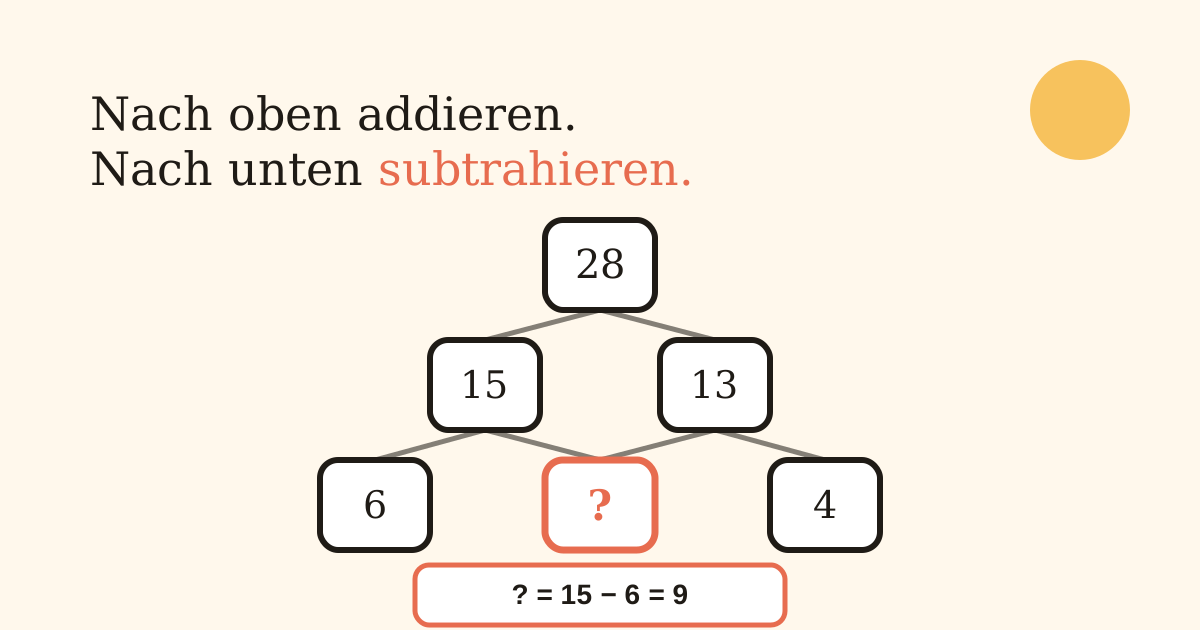
Five boxes, three numbers, no operators in sight — at first glance a number wall looks harmless. Each brick sits on top of the sum of the two bricks directly below it, and that's the whole rule. As long as all three bottom bricks are given, almost every child solves it in under a minute. The trouble starts the moment the wall is filled the other way round: a number sits at the top already, one is missing at the bottom — and suddenly addition alone doesn't get you there.
That switch between building up the wall and working back down it is exactly where many children in grade 2 and 3 get stuck. It doesn't take a new method to fix — just the confidence to subtract from a known sum instead of only ever adding.
The rule in one sentence
Each brick is the sum of the two bricks directly beneath it. If your child knows two of any three connected bricks, the third can always be found: missing the brick on top? Add. Missing one of the two below? Subtract the known lower brick from the one above it.
A simple three-brick wall makes this concrete: the bottom row holds 6, 9 and 4. Each middle brick comes from its two neighbours: 6 + 9 = 15 and 9 + 4 = 13. The top brick is then 15 + 13 = 28 — the sum of all three bottom bricks, just worked out in two steps instead of one.
Where the mistake comes from
As long as a number wall only needs building from the bottom up, it's pure addition — exactly what children already handle confidently by grade 1 or 2. But once a bottom brick is missing and only the top one is known, the wall demands a reversal that lessons often explain more briefly than they practise it.
- A child keeps adding when subtraction is what's needed, because "number wall" is mentally wired to "plus".
- When working backwards, the wrong number gets subtracted — say, the lower brick from the top one instead of the other way round — producing a negative or simply wrong result.
- When several bricks are missing in the same row, a child guesses instead of first finding the one brick that two known neighbours pin down exactly.
- A single slip at the very bottom quietly travels all the way up the wall, because nobody checks back partway through.
What your child can already build on
A number wall is really just a fact family stacked three storeys high: a child who already knows that 6 + 9 = 15 comes packaged with 15 − 9 = 6 and 15 − 6 = 9 already holds the tool every number wall needs. A number triangle made of the same three numbers — one your child may already know from school — shows this directly: 6, 9 and 15 always yield two addition facts and two subtraction facts.
Pocket money works the same way: knowing that 8 euros of allowance plus x euros of savings makes 20 euros, nobody tries random numbers for x — they simply work out 20 − 8. That same instinct is exactly what a number wall needs.
How to practise this at home in 10 minutes
A few drills that need no worksheet:
- Build a simple three-brick wall from three known bottom bricks all the way up, then check by adding all three bottom bricks directly into one sum for the top brick.
- Draw the same wall again, replace one bottom brick with a question mark, and give the matching neighbour plus the brick above it — your child now has to work backwards first.
- Build a wall together from three everyday numbers (family ages, a house number), then have you "erase" one for your child to work back out.
- After every wall, say the check out loud: "Do the two bottom bricks really add up to the one on top?"
What Talentists does differently
Our grade 2–4 worksheets deliberately mix both directions — walls built bottom-up, and walls with one number missing somewhere in the middle that require working backwards. A five-minute assessment shows whether your child already switches fluently between addition and subtraction or is still stuck on pure forward-building, and the worksheet starts exactly there. Stuck on one specific wall? A QR code gives a free explanation right next to it, no account needed.