Two short strokes, one pointed angle — yet almost no symbol in grade 1 maths trips children up as often as < and >. The two signs are exact mirror images of each other, look nearly identical from a distance, and their meaning depends entirely on which way the point faces. For a child who is still learning to tell b from d, that's one more source of confusion sitting right in the middle of the maths page.
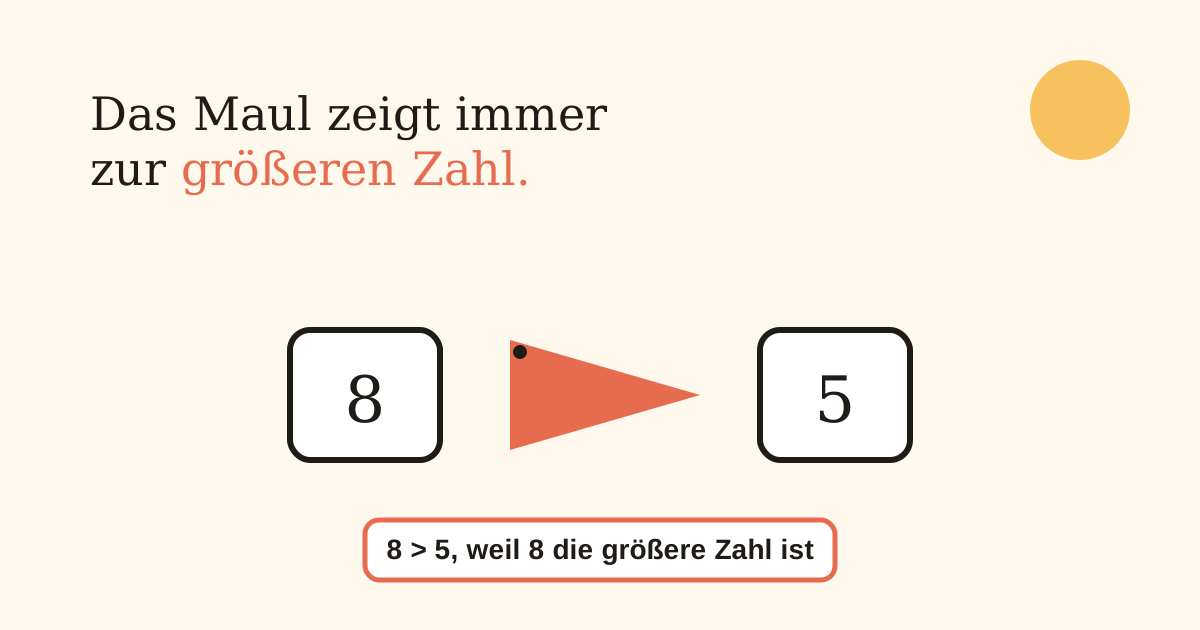
The crocodile mnemonic — "the mouth always eats the bigger number" — is familiar in almost every primary classroom. It genuinely helps, but only if a child can actually recall it at the moment two bare numbers sit on the page with an empty box between them.
The rule in one sentence
The wide-open end of the sign always faces the bigger number, and the point always faces the smaller one. With 8 and 5, 8 is the bigger number, so the sign opens toward the 8 and narrows to a point at the 5: 8 > 5. With 3 and 9 it's the other way round, and the sign opens toward the 9: 3 < 9.
It matters that "greater than" and "less than" always describe the sign itself, not its position in the sentence: > means "greater than" and < means "less than", regardless of whether the bigger number happens to sit on the left or the right of the sign.
Where the mistake comes from
The mistake almost never comes from not knowing which number is bigger — comparing itself is usually already solid. It comes from the mapping between direction and meaning not yet being automatic.
- A child knows the crocodile rule but flips it mentally, letting the mouth eat the smaller number instead.
- Given a blank template — just an empty box, no ready-made sign — < and > get mixed up because both have to be drawn from memory instead of merely recognised.
- When the order of the numbers being compared is swapped (smaller one named first), the sign from the last example gets reused automatically instead of being checked again.
- With multi-digit numbers, only the first digit gets compared and nothing after it, so 52 gets judged smaller than 49 because the 5 looks big at a glance while the tens place never gets read properly.
What your child can already build on
A balance scale is the sturdiest image: the heavier side sinks down, the lighter side tips up — exactly like the open end of the sign tips toward the "heavier", i.e. bigger, number. Anyone who has played with a balance scale, or knows a full glass is heavier than an empty one, already understands "more pulls more".
The number line offers a second mnemonic: whichever number sits further to the right is automatically the bigger one. A child who already reads the number line confidently can double-check any comparison that way instead of relying on the crocodile alone.
How to practise this at home in 10 minutes
A few drills that need no worksheet:
- Lay out two number cards (or two piles of objects in different amounts) and have your child say out loud which number is bigger before drawing any sign at all — keep comparing and sign-drawing deliberately separate.
- Only then trace the sign in the air with a finger while saying it out loud: "the mouth opens toward the 8, narrows toward the 5."
- Write five number pairs, alternating which one — bigger or smaller — comes first, so no automatic left-right pattern sets in.
- With two-digit numbers, have your child compare the tens digit out loud first and only look at the ones digit on a tie — exactly the step that gets skipped with 52 and 49.
What Talentists does differently
Our grade 1–2 worksheets deliberately train comparison tasks in both directions and with the number order varied, so no guessing pattern replaces real understanding. A five-minute assessment shows whether your child already separates comparing from sign direction reliably, and the worksheet starts exactly there. Stuck on one specific comparison? A QR code gives a free explanation right next to it, no account needed.