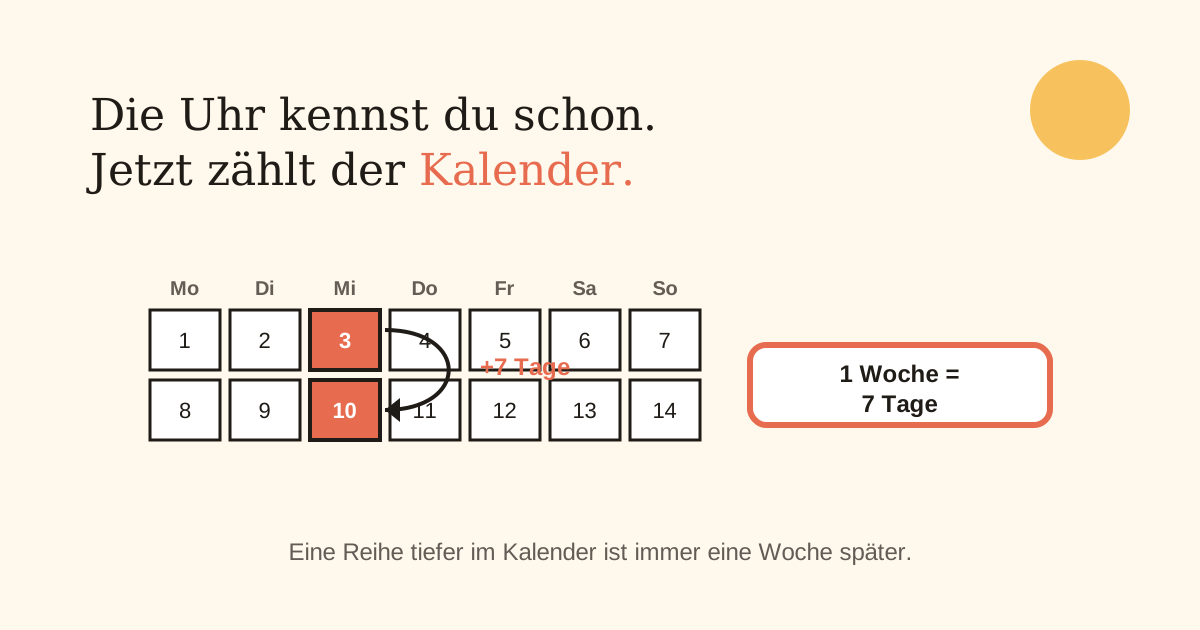
Your child can probably already reliably work out how much time lies between two clock times. The calendar asks a similar question, but with a new difficulty: not every unit is the same size. An hour always has 60 minutes, but a month has 28, 30 or 31 days depending on which one it is. Working from March 24th to April 2nd means looking more closely than a glance at the clock does.
The rule in one sentence
A week always has 7 days, a year always has 12 months — that's fixed. A month, on the other hand, has 28, 29, 30 or 31 days depending on which one it is, and that has to be known or looked up, not calculated.
The most reliable memory aid is the knuckle method: a closed fist shows alternating knuckles and dips, each knuckle stands for a month with 31 days, each dip for a shorter month — only February is the exception, with 28 days or 29 in a leap year.
Where the mistake comes from
The calculation itself is usually simple — the mistakes happen before that, in working out the right number of days per month or in counting precisely.
- Both the start and end day get counted — from the 3rd to the 10th of a month gets counted as 8 days instead of 7, because both the start and end day get counted twice, even though only the difference is asked for.
- A month gets treated as always having 30 days, even though it has 31 or only 28 — for calculations that cross a month boundary, this shifts the result by one to three days.
- The leap day on February 29th gets forgotten, or mistakenly counted in every year, even though it only exists once every four years.
- Weeks and days get added directly without converting to a shared unit first — 2 weeks and 4 days becomes "6" instead of 18 days.
What your child can already build on
The core idea is the same as with time spans on a clock: what's needed = end minus start. What's new is only that the "clock" is now the calendar, and the steps are counted in days instead of minutes.
Converting between units, which your child already knows from metres and centimetres, helps directly here too: weeks and days can always be converted to days, just as metres and centimetres get brought to a shared unit before calculating.
How to practise this at home in 10 minutes
A few drills that need no worksheet:
- Count together from one date to the next on a real wall calendar — for instance, how many days are left until the next birthday or the start of the holidays.
- Try the knuckle method on your own fist and ask for the number of days in each month of the year.
- Convert an appointment in the family calendar into weeks: "How many weeks until Easter?" — count the days first, then divide by 7.
- Write down a date and count a fixed number of days forwards or backwards, for example: "What day of the week is it in 10 days?"
What Talentists does differently
Our grade 3–4 worksheets practise calendar calculations with a real month sheet in view first, before plain number problems without a calendar picture, and drill the knuckle method as a fixed memory aid instead of just quizzing month lengths from rote memory.