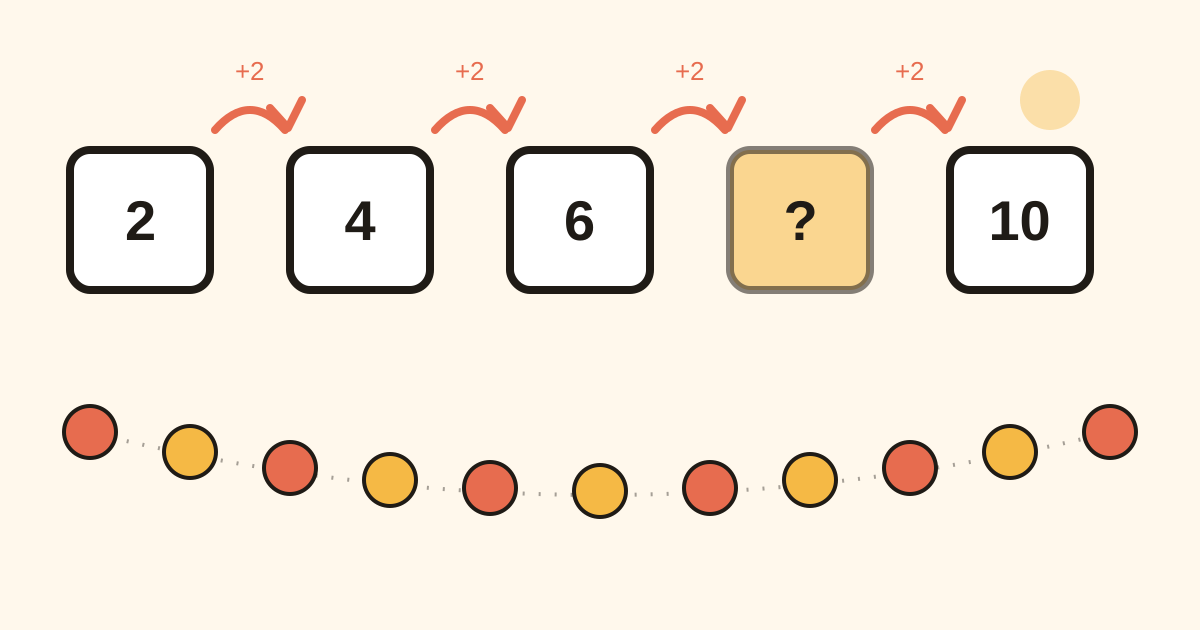
When parents think of primary-school math, most think of calculating: addition, subtraction, later multiplication and division. One whole strand of the curriculum often falls off the radar, even though it runs from grade 1 onward: patterns and structures — continuing number sequences, spotting regularities, seeing through swap facts.
This isn't a pretty extra. Spotting patterns is the skill that later sits behind algebra, behind clever calculation strategies, and behind understanding word problems. A child who sees structure has to memorise less — they derive instead.
Number sequences: more than filling a gap
“2, 4, 6, __, 10” looks like a simple fill-in-the-blank. In fact it demands something quite sophisticated: discovering the rule behind a sequence before you can continue it. That very move — find the rule first, then apply it — is the core of what later becomes algebra.
Practise it backwards too (20, 18, 16, __), with bigger steps (5, 10, 15, __), or from unusual starting points (3, 6, 9, __). The variety forces your child to actually hunt for the rule instead of repeating a memorised pattern.
Swap facts: the same sum, two viewpoints
3 + 5 and 5 + 3 give the same result — that sounds trivial, but it's one of the most useful discoveries of the primary years. A child who has internalised it only has to truly memorise about half of the times tables later on, because 6 × 7 and 7 × 6 are the same piece of information to them, just written the other way round.
The trick to make this visible: lay out buttons or building blocks in a grid — 3 rows of 5 or 5 rows of 3 are the same amount, just rotated. The picture stays in the head long after the rule has been put into words.
Patterns in shapes and everyday life
Patterns aren't only in number sequences. A tiled floor, a beaded necklace, a calendar — regularities can be found and described everywhere. On your next walk, ask: “What pattern do you see on this fence?”, or string a bead necklace together following a rule you invent as a family.
This isn't a detour from “real” arithmetic — it's the same mental move in different clothes, and children who spot patterns in their surroundings tend to transfer that skill to numbers more easily.
A check for the kitchen table
“How does this sequence continue — 20, 17, 14, __?” is a good test for children from grade 1/2 onward. If your child finds the rule (minus 3) and applies it confidently, that's a strong sign — stronger than many parents assume, because it shows structural thinking, not just calculation skill.
If your child needs a few tries: no cause for concern, just an invitation to restart with simpler sequences (steps of two, steps of five) and have them say the rule out loud before filling the gap.
Calculating is what shows up on the worksheet. Spotting patterns is what happens in the head before the first digit is written — and it's worth taking just as seriously at the kitchen table as the arithmetic itself.