Grade 3 is the year when a lot changes at once: numbers get bigger, calculation methods go on paper in columns, and the times tables are finally supposed to click completely. It can feel like everything is demanded at the same time — but it isn't. Most new topics build directly on what grade 2 already laid down.
As always: not a race, a corridor. Here are the core topics, each with a one-sentence check you can ask casually at the kitchen table.
Numbers to 1,000: reading place value confidently
New in grade 3 is the number range up to 1,000. Your child should be able to name the hundreds, tens and ones of a number and understand why 340 is more than 304, even though both use the same digits.
The check: “Which is bigger — 340 or 304? And how can you tell?” If the answer reasons about the hundreds digit rather than just guessing, place-value understanding is solid.
Column addition and subtraction — with carrying
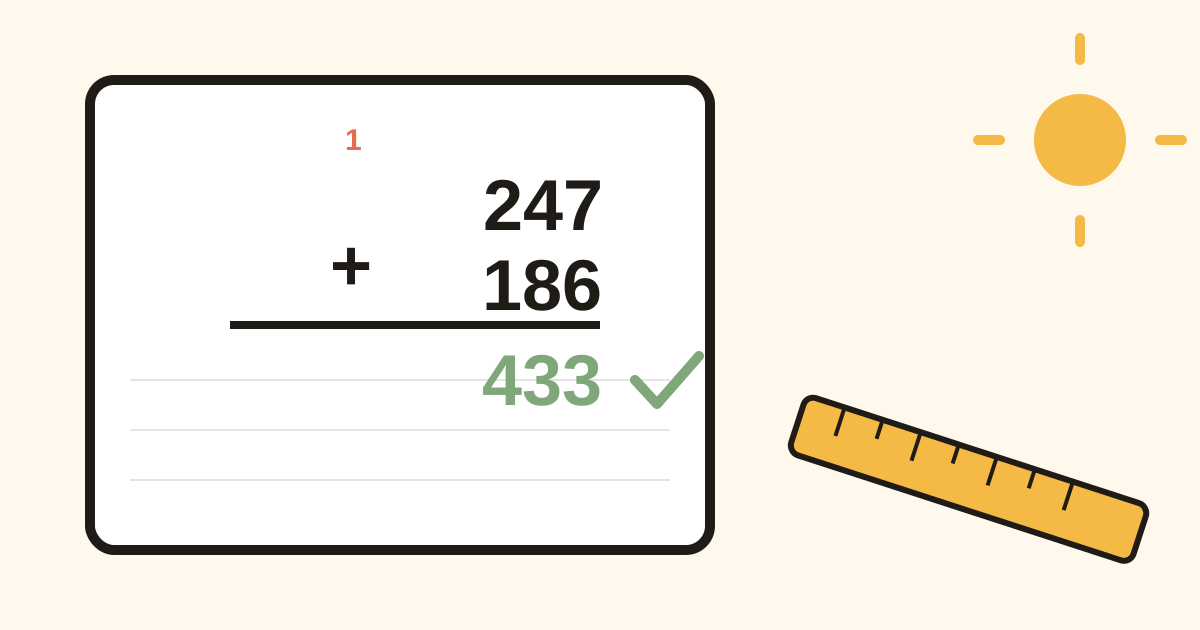
The big new method in grade 3: written column arithmetic, with carrying in addition and regrouping in subtraction. Unlike mental math, what matters here is that your child writes each step cleanly and in the right order — not just knows the final answer.
The check: have your child work out 247 + 186 in columns and say out loud what happens in each column. If the carrying step stalls, it helps to show what “one ten too many” actually means again with ten-rods or coins.
The times tables: now complete, including inverse facts
By the summer of grade 3, the entire times tables (all rows from 1 to 10) should be securely recallable — in both directions: 6 × 7 just as fast as the matching division fact 42 ÷ 7.
The check: “7 times 8?” — followed immediately by: “And 56 divided by 8?” If the second question takes noticeably longer than the first, targeted practice of the inverse facts pays off, not just the tables themselves.
First column multiplication
Toward the end of grade 3, written multiplication of a multi-digit number by a single digit is introduced, such as 234 × 3. The method is new, but the building blocks — times tables and place value — are not.
The check: work through a problem like 213 × 3 together in columns and ask: “What do you calculate first?” If your child starts with the ones, the method is understood.
Everyday units: length, weight, money, time
Grade 3 increasingly connects arithmetic to everyday units: meters and centimeters, kilograms and grams, euros and cents, time spans between two clock times. What matters most isn't the conversion itself but a feel for which order of magnitude is realistic.
The check: “Is a school desk more likely 70 cm or 70 m tall?” If your child can spot an obviously wrong order of magnitude, everyday number sense is on track — the exact conversion facts come with practice on their own.
What is NOT expected
Column division, numbers above 1,000 and fractions belong to grade 4. If your child doesn't have these yet in grade 3, nothing is missing — they're scheduled for later.
If something wobbles: close the gap without drama
A single wobbly topic in grade 3 is rarely a fundamental problem — usually it's a specific gap, often in the carrying step of column addition or in individual times-table rows. Ten minutes a day on exactly that one point closes most gaps within a few weeks.
If you want to know precisely where your child stands: our 5-minute check asks exactly these core topics and turns the result into a workbook that starts in the right places. No sign-up, straight from the kitchen table.