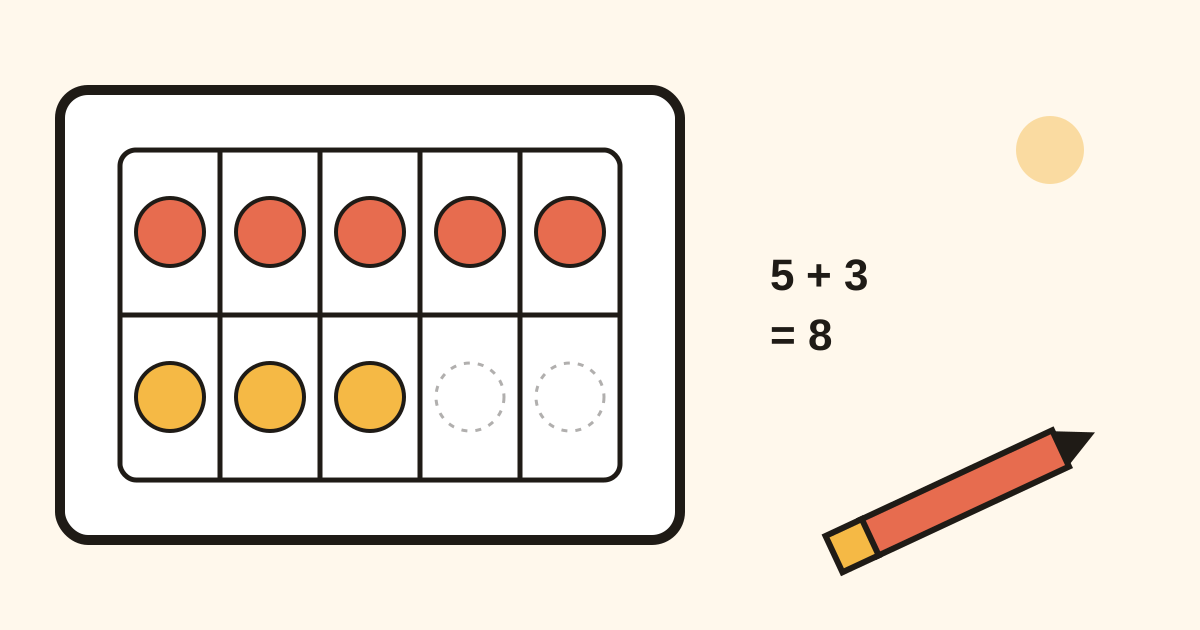
Grade 1 is the one year where things truly start from zero — which is exactly why any wobble here feels bigger than it is. Some children can already count to 100 on their first school day, others are just meeting the digits. Both are normal, and both lead to the same place by the end of grade 1.
Here are the core topics, each with a one-sentence check for the kitchen table. No test, no pressure — just an honest picture of where your child stands.
Numbers to 20: counting, ordering, comparing
The basis of everything: your child should count confidently in the range up to 20 — forwards, backwards, in steps of two — and compare two numbers by size without starting from one.
The check: “What comes after 14?” and “Which is bigger — 12 or 18?” An answer without long recounting means the foundation stands.
Decomposing numbers: grade 1's most important skill
Underrated but central: being able to split numbers into parts — 7 is 5 and 2, or 3 and 4, or 6 and 1. A child who knows these splits has the tool for practically every calculation to come, especially crossing ten in grade 2.
The check: “In how many ways can you split 8?” Finding two or three splits on the spot is a strong sign. The splits of 10 (9+1, 8+2, 7+3 …) matter most of all — they're needed throughout the next school year.
Addition and subtraction without crossing ten
Problems like 8 + 5 or 14 − 6, where the tens boundary isn't crossed, should run fluently by the end of grade 1. Crossing ten itself (say, 8 + 7) isn't expected yet — that's grade 2's territory, and it builds directly on the decomposing skill above.
The check: “What's 8 plus 5?” The path matters more than the speed: does your child count up on fingers out loud, or recall the answer? Either is completely fine at this stage.
Doubling and halving — the first steps
Doubling small numbers (double 4, double 6) already belongs to grade 1 and is a preview of the times tables to come. Halving even numbers up to 10 rounds this off.
The check: “What's double 5?” A confident answer here lays an important foundation for grades 2 and 3.
Sizes and patterns: the first touchpoints
Alongside this come the first, still playful touchpoints with sizes: comparing lengths directly (“which is longer?”), simple cent and euro amounts, telling time on the hour. And with patterns: continuing number sequences (2, 4, 6, __) and discovering the first swap facts (3 + 5 is the same as 5 + 3).
The check: “How does the sequence continue — 5, 10, 15, …?” This isn't a side topic — it's the first contact with structure your child will keep meeting everywhere in maths.
What is NOT expected
Just as important: crossing ten, the times tables and numbers beyond 20 belong to grade 2. If your child can't do them yet, nothing is missing — they're next year's topic.
If something wobbles: close the gap without drama
A wobbly topic in grade 1 is rarely a cause for concern — much settles on its own in the first months of school. What helps is always the same recipe: ten minutes a day, one single topic, accuracy before speed.
If you want to know precisely where your child stands: our 5-minute check asks exactly these core topics and turns the result into a workbook that starts in the right places. No sign-up, straight from the kitchen table.