Even and odd numbers are one of the first proper maths concepts children meet in grade 1 or 2 — and one of the first where a shortcut outruns the understanding behind it. "Ends in 0, 2, 4, 6, or 8 means even" is quick to memorise and works reliably. But a child who knows the trick without knowing why it works stumbles the moment a question breaks the pattern.
That's exactly what happens in practice: a child can confidently say 24 is even but can't explain why — and suddenly hesitates on a question like "why is 24 even?", or on a larger, unfamiliar number. The last-digit check is a genuinely useful shortcut, but only once the principle underneath it has landed.
The rule in one sentence
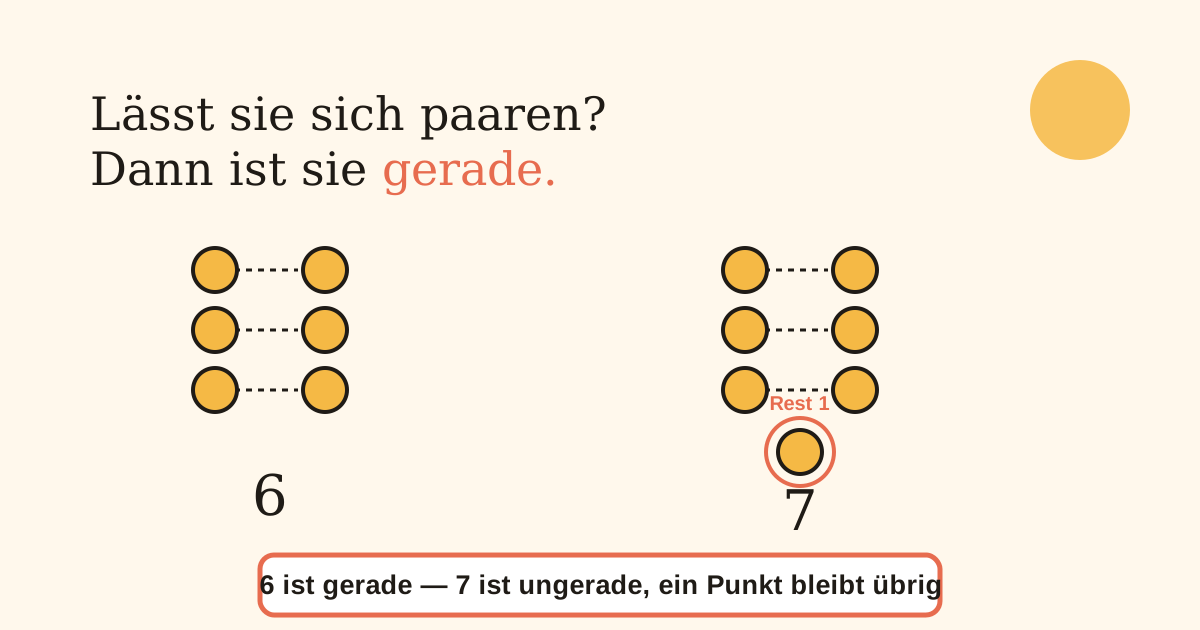
A number is even if every one of its objects can be split into pairs with nothing left over; if one object is left standing alone, the number is odd. 6 dots make exactly three pairs — even. 7 dots make three pairs and one leftover dot — odd.
The last-digit shortcut works because every number is made of complete groups of ten plus whatever the last digit adds, and each group of ten already splits into pairs with nothing left over. So whether 24 or 2,024 is even depends only on the last digit — not as an arbitrary rule, but because every ten, hundred, and thousand is already pairable.
Where the mistake comes from
Almost every mistake here comes from learning the shortcut without the picture behind it.
- A child can recite the digit list from memory but can't explain why 8 is even — faced with an open question instead of a yes/no check, they guess instead of reasoning it out.
- "Even" gets confused with "round", so only numbers like 10, 20, or 100 count as even, and a number like 14 gets mistakenly called odd.
- When skip-counting by twos (2, 4, 6, 8 …), a child assumes only the numbers said out loud are even and everything in between is automatically odd — when in fact unmentioned even numbers like 14 or 26 were simply skipped over in the counting, not excluded from being even.
- 0 doesn't register as a proper number, so it's unclear whether it's even or odd at all — it's even, because zero objects split into zero pairs with nothing left over.
What your child can already build on
Sorting sock pairs out of the laundry, lining up shoes two by two, or splitting sweets fairly between two children — all of it is the exact same pairing logic behind even and odd, just without the vocabulary. A child who has already noticed that 7 sweets can't be split evenly between two people already understands "odd" intuitively.
Skip-counting by twos, which most children pick up in grade 1, is also a good bridge — as long as it's clear that the point is to list even numbers, not to rule out every number that wasn't named.
How to practise this at home in 10 minutes
A few drills that need no worksheet:
- Count out a handful of buttons, Lego bricks, or coins and have your child sort them into pairs — if one is left over, the number is odd, and your child sees the answer instead of guessing it.
- With two-digit numbers, guess first from the last digit, then check with a smaller number ending the same way (e.g. 34 and 4) to see if the pairing picture gives the same answer.
- Sort number cards from 0 to 20 into two piles — even and odd — and have your child explain each choice out loud, not just state the digit.
- Try a question like "even plus even" with real objects and see whether the result is pairable too — a natural next step once the basic rule is solid.
What Talentists does differently
Our grade 1–2 worksheets deliberately ask for a reason on even/odd questions, not just a tick — exactly the step that turns memorising into real understanding. A five-minute assessment shows whether your child already connects the digit rule to the pairing principle behind it, and the worksheet starts precisely where the gaps show up. Stuck on one specific number? A QR code gives a free explanation right next to it, no account needed.