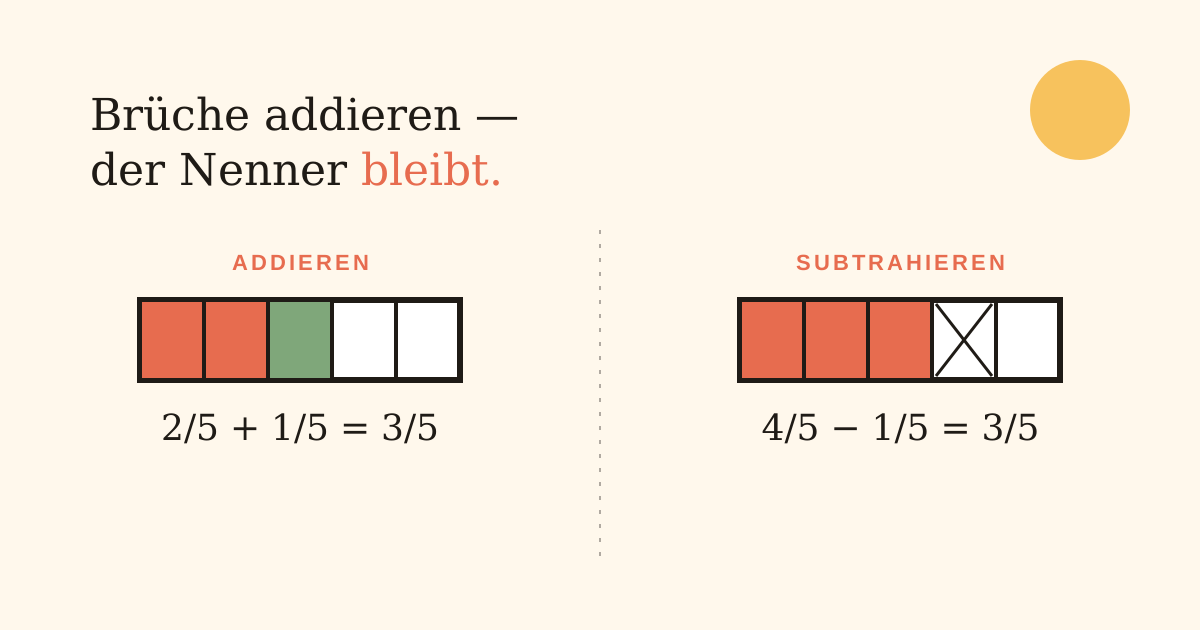
Once a child understands that ¾ means "three of four equal parts", the next question follows almost automatically: what happens when two such fractions come together? 2/5 of a cake plus 1/5 of a cake — how much is that in total? The answer sits closer to hands-on sense than the plus sign suggests: it isn't two whole fractions being added, only the number of parts — as long as the parts are the same size.
That "as long as" is exactly where many children do the opposite of what's needed: they add the numerators and the denominators, because that feels right given everything learned about whole numbers so far. But fraction addition doesn't need a new rule here — just a new picture.
The rule in one sentence
When two fractions share the same denominator, only the numerators get added or subtracted — the denominator stays exactly as it was. 2/5 + 1/5 = 3/5, not 3/10, because adding them together doesn't make the fifths any bigger or smaller, it just takes more of them.
The cake picture makes this click instantly: a cake is cut into 5 equal slices. Two slices plus one slice is three slices — the cake itself was never re-cut in the process, so the 5 in the denominator stays exactly 5.
Where the mistake comes from
The mistake almost always shows up at the same spot — and for an understandable reason.
- The denominator gets added along with the numerator, because that feels familiar from whole numbers (3 + 2 = 5) — but with fractions, the denominator describes the size of the parts, not a quantity being counted up.
- Two fractions with different denominators, say ½ + ⅓, get added straight across (numerator to numerator, denominator to denominator) without recognising that halves and thirds are different-sized parts that first need to be brought to equal-sized parts before any addition is valid.
- When subtracting, the smaller numerator sometimes gets taken from the bigger one regardless of which order the fractions appear in the problem — the same order-swap mistake children make with whole numbers.
- A result like 5/5 doesn't get recognised as "one whole", because the child stays fixed on the fraction notation instead of checking whether the numerator and denominator have become equal.
What your child can already build on
A child who already understands that the denominator says how big the parts are, and the numerator how many of them are meant, already has the core of the addition rule: equal-sized parts add up like equal things do — 2 apples plus 1 apple is 3 apples, 2 fifths plus 1 fifth is 3 fifths. The denominator is just the name of the kind of part, not something that enters the calculation.
Knowing about equivalent fractions (½ = 2/4) carries over directly too: a child asked to add ½ and ⅓ can picture both as different, equal-sized fractions sharing the same denominator — that's exactly the idea behind bringing fractions to equal-sized parts, just without needing the technical term for it yet.
How to practise this at home in 10 minutes
A few drills that need no worksheet:
- Fold two equal strips of paper into the same number of parts (say, both into sixths), colour a different number of parts on each, then add the coloured parts together — the result can be read off directly, not just calculated.
- While sharing a pizza or chocolate bar, count out loud: "I have 2 of 8 pieces, you have 3 of 8 pieces, together that's …" — and only write the numbers as a fraction afterwards.
- Have your child deliberately name results like 4/4 or 6/6 as "one whole" the moment numerator and denominator become equal.
- Before any subtraction, always ask first: "are the parts the same size?" — that habit alone prevents calculating with mismatched denominators.
What Talentists does differently
Our grade 3–4 worksheets train fraction addition exclusively with matching denominators at first, until the numerator/denominator distinction is solid, and only then introduce mixed denominators through the same hands-on picture already used to build understanding of fractions. A five-minute assessment shows whether your child is still adding denominators along the way or is ready for mixed denominators, and the worksheet starts exactly there.