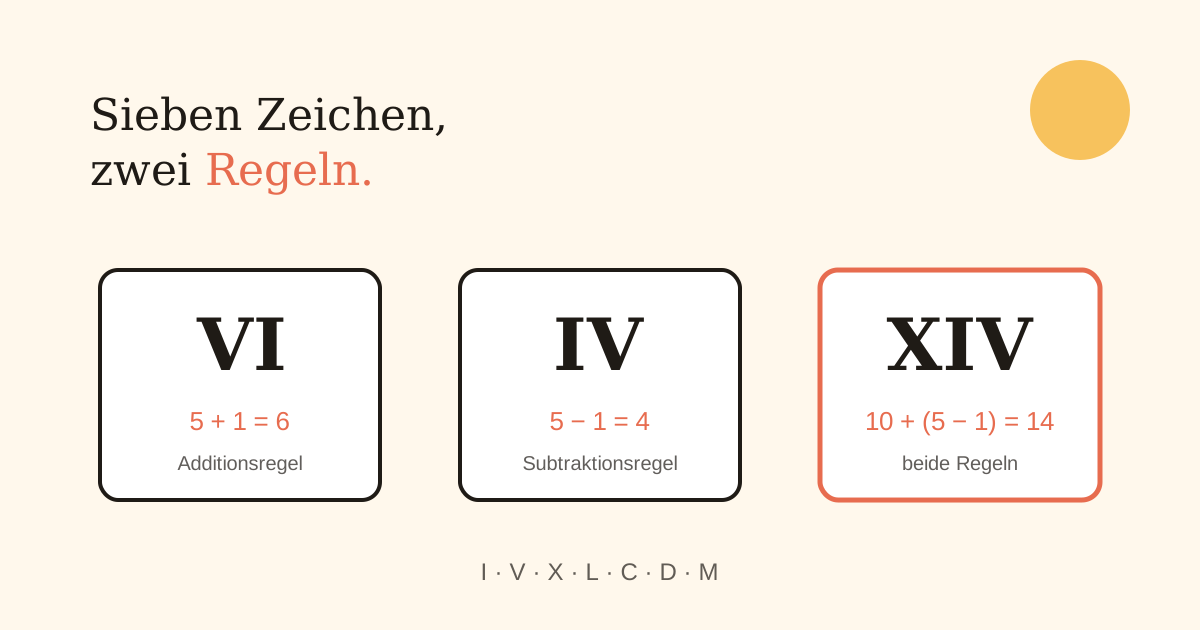
Roman numerals often feel like a secret code to kids: they show up on church clock faces, on the title page before book chapters, in movie credits and at the Olympic Games. Unlike our familiar base-ten system with digits 0 to 9, the Roman system uses only seven basic symbols — plus two rules that let you build any number from them.
In years 3 or 4, the topic usually shows up as a small side excursion rather than core material — which is exactly why it's useful for understanding number systems in general: our base-ten system isn't the only possible way to write numbers, just the one we're most used to.
The seven basic symbols
The whole system is built on just seven letters, each with a fixed value:
- I = 1
- V = 5
- X = 10
- L = 50
- C = 100
- D = 500
- M = 1000
The addition rule
When a smaller or equal symbol follows a bigger one, the values are added: VI is 5 + 1, so 6. XV is 10 + 5, so 15. Many numbers can simply be built by stringing symbols together — as long as the same digit doesn't appear more than three times in a row.
The subtraction rule
When a smaller symbol comes before a bigger one, though, it gets subtracted: IV is 5 minus 1, so 4 — not IIII, which wouldn't be allowed anyway. IX is 10 minus 1, so 9. This rule only applies to specific pairs, not just any combination: I may only come before V or X, X only before L or C, C only before D or M. IL for 49, for example, is wrong — the correct form is XLIX (40 + 9).
Common mistakes
Most stumbling blocks aren't in the principle but in details that are easy to overlook:
- Writing IIII instead of IV for 4 — a symbol may appear at most three times in a row, after that the subtraction rule has to kick in.
- Symbols in the wrong order — big to small, with the allowed subtraction exceptions placed before, never mixed at random.
- A symbol that's far too small placed before a much bigger one — only I, X and C may ever be subtracted, and each only before two specific larger symbols.
- Values simply added up without paying attention to order — VI and IV look similar but mean 6 and 4 respectively.
What your child can already build on
The place-value system your child already knows from working with large numbers — ones, tens, hundreds — actually helps by contrast, precisely because Roman numerals work differently: there are no place values, the position of a symbol determines whether it's added or subtracted instead. That contrast often makes it click just how convenient our own base-ten system really is.
How to practise this at home in 10 minutes
A few drills that need no worksheet:
- Find an analogue clock with Roman numerals (or draw one) and read off together which number sits at which hour.
- Write your child's own birth year in Roman numerals — a four-digit year is good practice for all seven basic symbols at once.
- Look for the copyright year in Roman numerals at the end of a film's credits or a news broadcast.
- Translate chapter numbers in a book written in Roman numerals (often in the table of contents) into ordinary numbers, and back again.
What Talentists does differently
Our worksheets introduce the subtraction rule only once the addition rule is solid, and drill the two separately before mixed tasks combining both show up.