From grade 3 onward, alongside the written calculation methods, a small and often underrated topic appears: rounding, usually taught as “estimating” (Überschlagsrechnen). It looks like a footnote in the curriculum — but it's the only tool a child has to check their own calculation without asking anyone.
The idea is simple: before working out 397 + 486 exactly, you estimate roughly — about 400 plus about 500 is about 900. If the exact answer comes out at 883, that fits the estimate. If it comes out at 388, something is off — and it shows before the result gets written down as final. That's exactly what makes estimating the most effective error check primary-school children have available.
The rounding rule: five is enough
The rule itself is quick to state: from the digit 5 upward you round up, below that you round down. 34 becomes 30, 38 becomes 40 — the five itself is the tipping point and also rounds up. For tens you look at the ones digit, for hundreds the tens digit, for thousands the hundreds digit. The principle stays the same; only the place you're watching shifts.
The order matters: first decide the target place (“I'm rounding to the nearest hundred”), then look at exactly one digit to its right, then decide. A child who instead rounds digit by digit from right to left runs straight into the mistake covered next.
The most common mistake: rounding twice
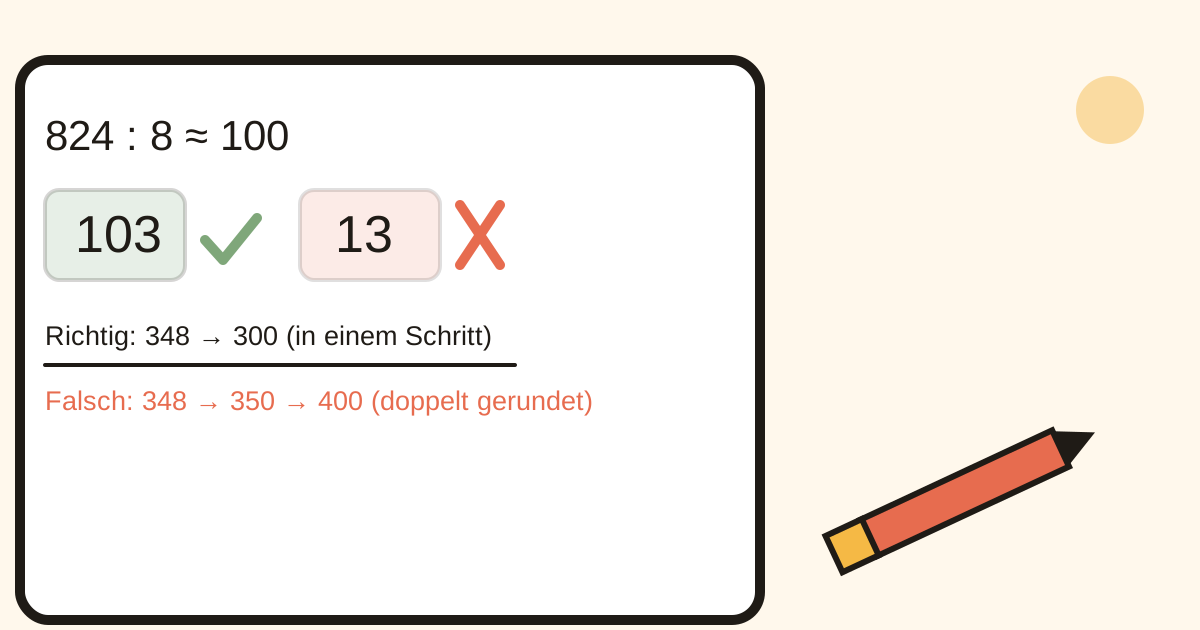
By far the most common rounding mistake is rounding in stages across several places. A child is asked to round 348 to the nearest hundred. The correct move: look at the tens digit (4), round down, answer 300. What often happens instead: round to the nearest ten first (348 → 350), then round that intermediate result to the nearest hundred (350 → 400). The answer 400 is wrong — the correct answer is 300.
The mistake feels logical because each individual rounding step is carried out correctly on its own. The problem is rounding in two stages instead of one. The fix is simple but effective: always jump directly from the original number to the target place, never via a rounded intermediate result.
What estimating is actually good for, day to day
The benefit shows up most clearly right where the written methods are being practised — addition, subtraction, multiplication, division (see our posts on carrying and on long division). Before any written calculation, a quick estimate is worth it: is the result roughly in the expected range?
The exact mistake from our long-division post — the vanishing zero that turns 103 into 13 — jumps out immediately under an estimate: 824 ÷ 8 is roughly 800 ÷ 8, so about 100. An answer of 13 clearly contradicts that estimate. The child doesn't even need to understand the mistake to notice something's wrong — the estimate alone is the alarm bell.
The routine: estimate first, calculate, then compare
These three steps can be trained on every larger calculation from grade 3 onward:
- Estimate before calculating: round both numbers to a sensible place and estimate in your head.
- Calculate exactly: solve the actual problem as usual, written or mental.
- Compare: does the exact result match the estimate? If it's far off, a second look is worth it before calling the result final.
Estimating never replaces the exact result — but it's the one check a child can give themselves, without depending on an adult or a calculator. Children who build this routine early carry it with them well beyond primary school.