Long division is, chronologically, the last of four written methods primary-school children learn — after column addition and subtraction with carrying, after column multiplication. That's no accident: division needs all three earlier skills at once. Dividing means multiplying mentally (to estimate how many times the divisor fits), subtracting (to find the remainder), and keeping track of which place is currently being worked on.
That pile-up is exactly why many grade-4 children hit a real wall here for the first time — not because one single skill is missing, but because four skills have to run simultaneously. The good news: if times tables, carrying and the basic idea of sharing (see our post on learning division) are already solid, long division is mostly a new order of familiar steps.
The basic principle: place by place, left to right
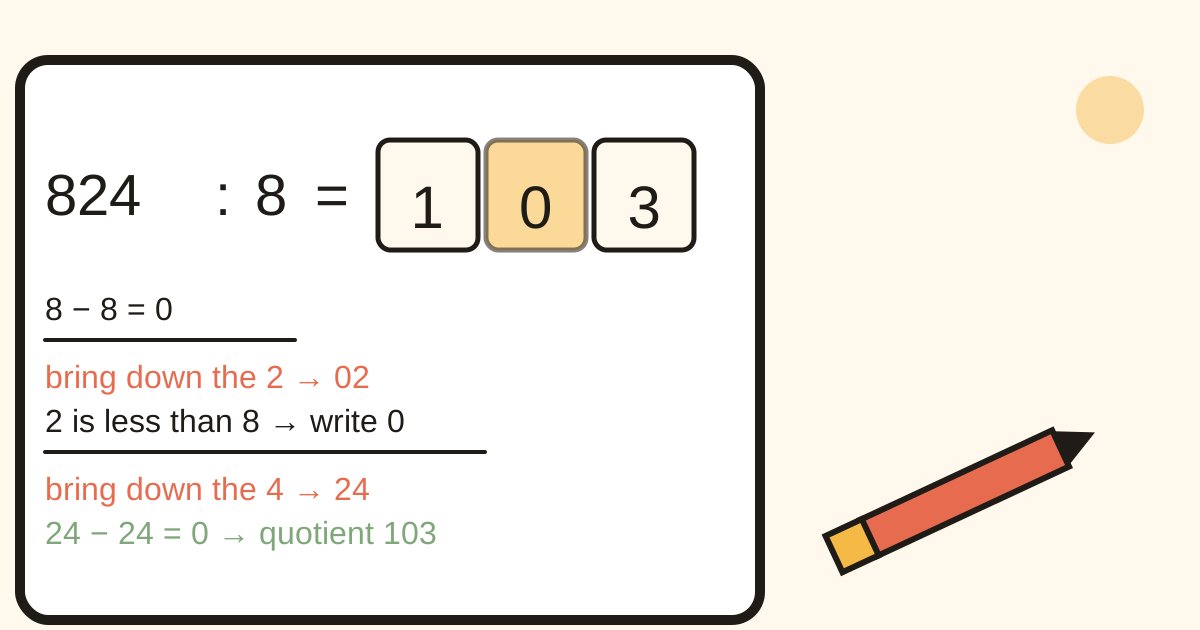
Unlike the other three written methods, division works left to right, not right to left. Played out on 824 ÷ 8: first the highest place — does 8 fit into 8 (the hundreds)? Yes, exactly once, remainder 0. The 1 becomes the first digit of the quotient.
Now the next digit gets brought down: the remainder 0 and the next digit 2 become 02. Does 8 fit into 2? No — 2 is smaller than the divisor. Here comes the step many children skip: because 8 doesn't fit into 2, a 0 goes into the quotient, and the next digit gets brought down. 2 and the 4 become 24. Does 8 fit into 24? Exactly three times, no remainder. The quotient: 103.
The vanishing zero — the most common mistake
That exact case — a place the divisor doesn't fit into — causes by far the most common long-division mistake. Instead of the correct 0, many children simply skip the place and end up writing 13 instead of 103. At first glance the result looks almost right — but it's off by a whole power of ten.
The cause isn't carelessness; it's that a 0 in the quotient feels different from a 0 anywhere else: it seems to say “nothing happens here”, even though it matters mathematically just as much as any other digit. The fix: for every digit brought down, ask out loud “does the divisor fit here at least once?” — and on “no”, write the 0 just as deliberately as a 3 or a 7.
When a remainder is left at the end
Not every division comes out even. For 85 ÷ 6, the 6 fits into 8 once, remainder 2; bringing down the 5 makes 25 from the 2 and 5. The 6 fits into 25 four times (6 × 4 = 24), remainder 1. Since no digit is left, the calculation ends here: 85 ÷ 6 = 14 remainder 1.
In primary school the remainder is left exactly as that — “remainder 1” — not carried on as a decimal. That comes deliberately later. Important for parents: a remainder isn't an unfinished result, it's a complete, correct result in this notation.
Three stages of practice
If the method still wobbles, this order helps — each stage solid before the next begins:
- Stage 1 — problems that divide evenly with no zero place: numbers like 936 ÷ 4 or 848 ÷ 4, where the divisor fits into every place at least once. This settles the basic flow without the extra hurdle.
- Stage 2 — deliberately include the zero place: practise problems like 824 ÷ 8 and ask the check question out loud before writing the digit. This stage deserves the most time.
- Stage 3 — problems with a remainder: only once stage 2 is solid, add problems like 85 ÷ 6 where the division doesn't come out even.
With long division, all four major written methods of primary school are complete — addition, subtraction, multiplication and division all ultimately rest on the same two skills: solid times-table and addition facts, and the patience to work place by place instead of shortcutting the order.