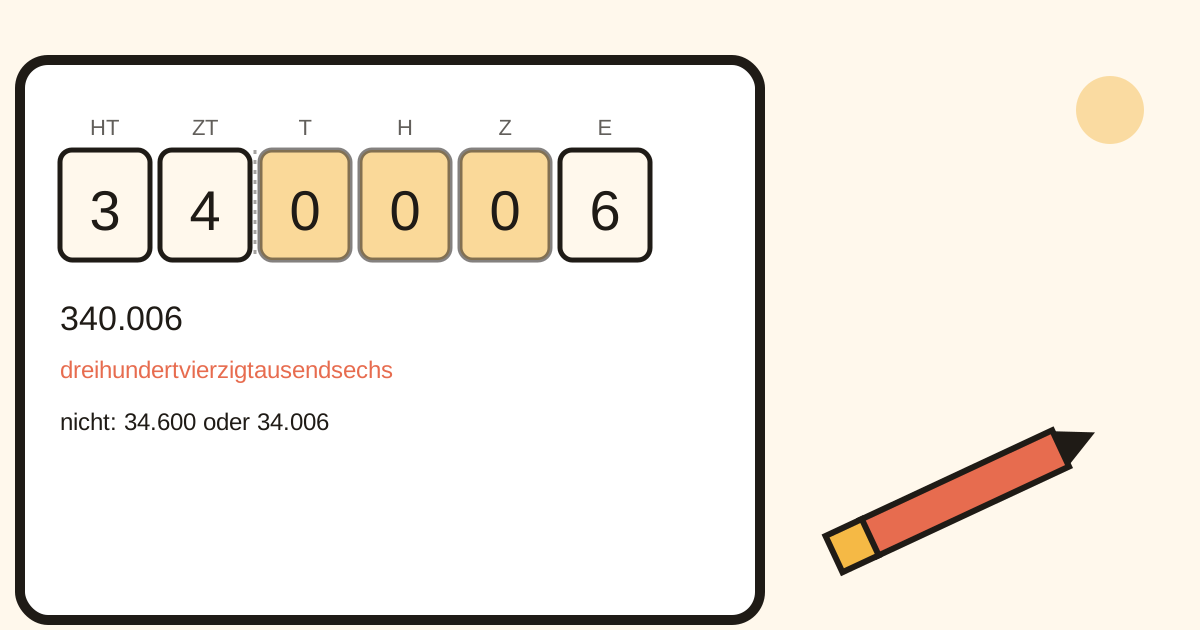
Through grade 2 the number range mostly tops out at 100, in grade 3 at 1,000 — and then it moves fast: ten-thousands, hundred-thousands, eventually a million. For children that jump is bigger than the curriculum heading suggests. It's not just about counting further, it's about recognising every digit of a number at its correct place.
That's exactly where the classic mix-ups start: 40,006 and 4,600 look similar at a glance but differ by more than a factor of eight. A child who can't confidently name the place values will mix the two up easily — not from carelessness, but because the underlying system isn't yet internalised.
The place-value table: the most important tool
The most reliable aid is a simple table of columns — right to left: ones, tens, hundreds, then (set off by a small gap or a period, as German number formatting does) thousands, ten-thousands, hundred-thousands, then millions. Every digit of a number gets exactly one column, no more and no fewer.
Enter 340,006 into that table and it immediately shows why it differs from 34,600: in one number the zeros sit in the hundreds, tens and ones place in the middle, in the other they sit somewhere else entirely. Without the table it stays a gut feeling; with it, it becomes a row you can simply read off.
The trap: zeros as placeholders
The most common mistake when writing large numbers is dropping a zero in the middle. “Forty thousand and six” (40,006) quickly becomes “4,006” or “40,06” on paper — the two zeros between the ten-thousands and the ones place disappear because they don't stand out when spoken.
The reason: speech only names what's non-zero — nobody says “forty thousand zero hundred zero tens six”. Writing, though, needs a digit in every single place, even where it's a 0. The counter-exercise: before writing, go through the place-value table out loud, column by column, and deliberately put a 0 in every empty one.
When number words lead you astray
German number words make large numbers extra tricky because they don't always mirror digit order — a quirk worth knowing if you're helping in German. “Einundzwanzig” (21) literally says “one-and-twenty”: the ones digit first, the tens digit second, the reverse of how 21 is written. In bigger numbers the same reversal repeats one level up.
This so-called digit-reversal isn't a quirk of individual children — it's a well-known feature of German that trips up learners internationally, since many other languages say tens before ones. Knowing that lets you file the mistake correctly: not as a calculation error but as a translation glitch between spoken and written number. Saying the number aloud while writing digit by digit at the same time helps decouple the order.
Practice: from everyday life to the place-value table
Large numbers feel abstract as long as they only live in the maths exercise book. Everyday references make them concrete:
- Price tags and odometers: how many residents does the nearest city have? How many kilometres does the family car's odometer show?
- Break numbers apart and rebuild them: say 340,006 out loud, enter it into the place-value table, then write it back as a digit sequence — without the table.
- Find neighbouring numbers: given a large number, find the next round ten-thousand or hundred-thousand up — this trains a feel for order of magnitude.
The large number range isn't a new subject — it's the same place-value idea that already applies to small numbers, just with more columns. Once the place-value table is solid, millions become just as natural as hundreds once were.