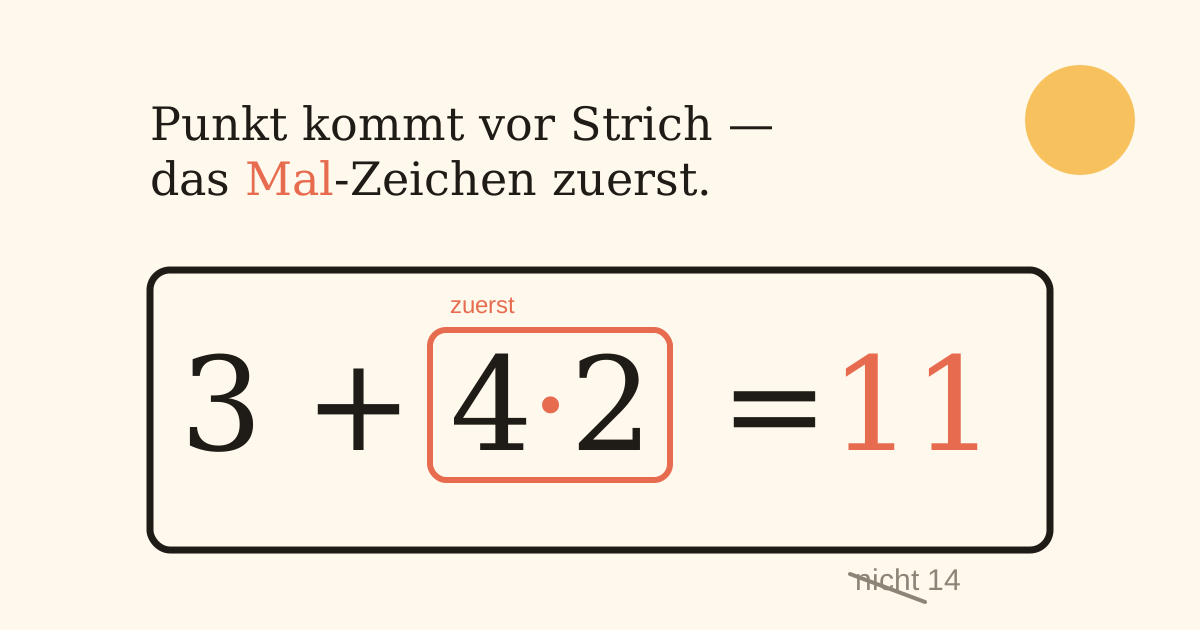
"What's 3 plus 4 times 2?" Plenty of children just work left to right: 3 plus 4 is 7, times 2 is 14. The calculation feels logical, but it's wrong — the answer is 11. Once plus, minus, times and divide start showing up in the same problem in grade 3 or 4, the order suddenly becomes the real challenge, not the arithmetic itself.
The good news: the rule behind it is short, and once it clicks, the mistake almost always disappears for good.
The rule in one sentence
Multiplication and division come before addition and subtraction, no matter where they sit in the problem. At 3 + 4 × 2, the 4 × 2 gets calculated first — that's 8 — and only then does the 3 get added, giving 11.
When several multiplications/divisions or several additions/subtractions sit next to each other, they're simply worked left to right as usual. And wherever parentheses appear, an even higher rule kicks in: whatever's inside parentheses gets calculated first, no matter what.
Where the mistake comes from
The order-of-operations mistake isn't a sign of weak arithmetic — it's the logical result of how children learn to read and calculate: left to right, step by step. As long as a problem only uses one type of operation, that rule works perfectly. It's only once addition/subtraction and multiplication/division get mixed that a second, invisible rule suddenly applies — and it contradicts the reading direction kids are used to.
- 3 + 4 × 2 gets read left to right as (3 + 4) × 2 = 14, instead of applying multiplication first.
- 20 − 8 ÷ 4 becomes (20 − 8) ÷ 4 = 3 instead of the correct 20 − 2 = 18.
- Parentheses get skipped over or read as pure formatting, instead of as an instruction meaning "this part first."
- In longer chains like 2 + 3 × 4 − 5, only the first operation from the left gets special treatment, and the rest is left in its original order.
What your child can already build on
Money makes the rule concrete again: €3 plus 2 bags of gummy bears at €4 each — what's the total? Nobody would add 3 and 2 first and then multiply by 4; everyone automatically works out the two bags first (2 × €4 = €8) and then adds the €3. That's exactly multiplication-before-addition, just done in your head instead of on paper.
Colour also helps: mark every multiplication or division in a mixed problem with a pen before calculating anything. Whatever's marked gets solved first — the rest follows afterward in the usual order.
How to practise this at home in 10 minutes
A few concrete drills that need no worksheet:
- Colour-mark every multiplication/division in a mixed problem before calculating, then solve.
- Invent a tiny real-world story (money, bags, groups) for a problem like 3 + 4 × 2 that shows which part belongs together first.
- Add parentheses on purpose and compare: how does the answer change from 3 + 4 × 2 to (3 + 4) × 2?
- Check the result against a calculator that applies the rule correctly.
What Talentists does differently
Our grade-3 and grade-4 worksheets only introduce mixed calculations once addition/subtraction and multiplication/division are each solid on their own — and then train the order deliberately with problems designed to provoke exactly this mistake. A five-minute assessment shows whether your child already applies the rule or is still working strictly left to right, and the worksheet starts exactly there. Stuck on one specific problem? A QR code gives a free explanation right next to it, no account needed.