Once the times tables are reasonably solid, school usually moves on quickly to the next operation: division. For many children this feels like a step backwards — the tables had only just become automatic, and now a whole new move is expected. But division isn't a brand-new skill built from scratch — it's the flip side of what your child already knows.
The real snag lies elsewhere: division carries two quite different meanings in the mind, and textbooks switch between them without always saying so out loud. A child who knows both pictures understands the calculation. A child who only knows one often gets the right answer without quite knowing what just happened.
Grouping or sharing — two pictures, one calculation
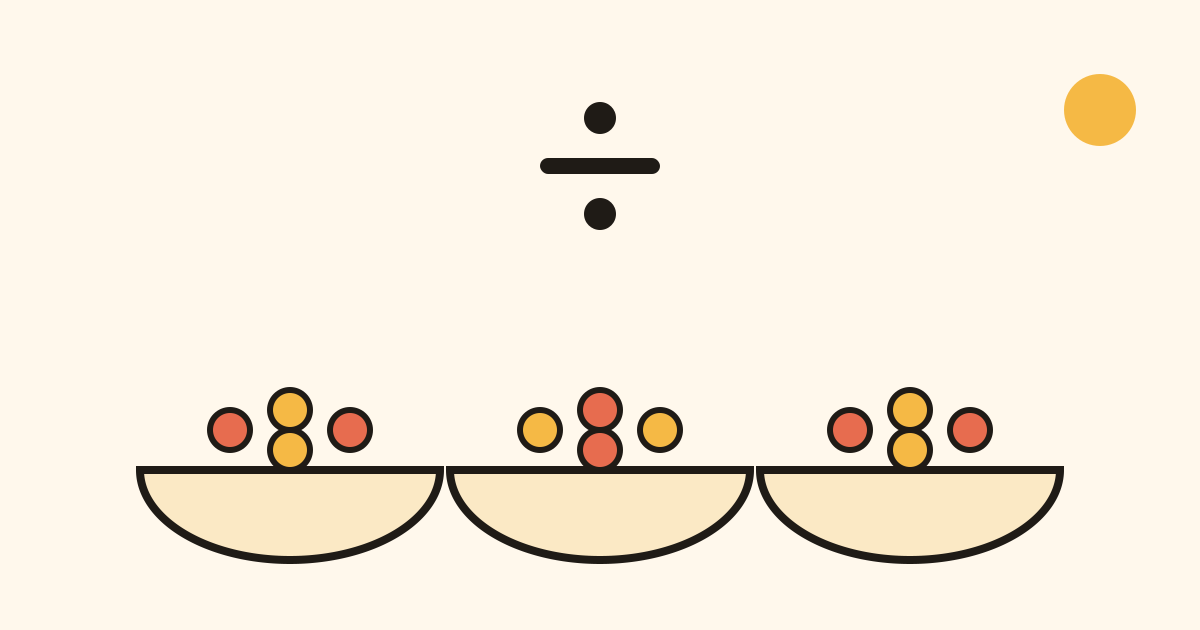
12 ÷ 3 can be told two ways, and both lead to the same result but through different reasoning. Sharing: 12 sweets are shared equally among 3 children — how many does each child get? Grouping: 12 sweets are packed into bags of 3 — how many bags will there be?
In sharing, the number of groups is known (3 children) and the group size is what's sought. In grouping, the group size is known (3 per bag) and the number of groups is what's sought. Identical arithmetic, two different mental actions — and a child holding only one of the two pictures struggles with word problems built on the other.
The simplest way to cement both pictures: act it out with real objects. Sweets, building blocks or buttons can be shared into a fixed number of bowls once, and grouped into fixed group sizes another time — same pile, two questions.
Division is the flip side of the times tables
The fastest route to division isn't fresh memorising — it's the tables your child already knows. Solving 12 ÷ 3 means asking: which number times 3 gives 12? The 3-times table gives the answer directly — 3 times 4 is 12, so 12 ÷ 3 = 4.
That's why it pays to never practise division in isolation, but always right alongside the matching times table. Alternate asking: “What's 3 times 4?” and “What's 12 divided by 3?” — the same fact family, viewed from two directions. A child who can reliably recall the 3-times table barely needs to learn the matching division at all — just recognise the question in its new shape.
Division with remainders: when it doesn't come out even
13 sweets can't be shared evenly among 3 children. Each child gets 4, and one sweet is left over — 13 ÷ 3 = 4 remainder 1. That's not a “wrong” division — in primary school it's the standard case: most everyday problems simply don't divide evenly.
The remainder initially looks like a mistake to many children. A fixed check question helps: is the remainder enough for one more full group? For 13 ÷ 3 it isn't — 1 is smaller than 3. That's exactly the test a child can use to verify their own remainder: it must always be smaller than the number being divided by.
The most common mistake
The typical stumble isn't dividing wrong as such — it's a remainder that's too big or too small, for example 13 ÷ 3 = 3 remainder 4. That shows the calculation stopped before reaching the largest possible full group. The check catches it reliably: 3 times 3 is 9, plus a remainder of 4 does add up to 13 — but because the remainder is bigger than the divisor, at least one more full group of three was still hiding in there.
Practise in three steps
If division still wobbles, this order helps:
- Step 1 — act it out: use real objects to play through both pictures, sharing and grouping, until both feel familiar.
- Step 2 — link to the times table: for every solid table, quiz the matching division facts too — one fact family, not two separate topics.
- Step 3 — division with remainders: only once even divisions run smoothly, add the check question “is the remainder smaller than the divisor?”
Division isn't a leap into the unknown — it's a second look at knowledge that's already there. A child who can recall the times tables and has physically experienced what sharing and grouping mean quickly loses their wariness of division — remainder included.