234 times 26, in your head? Barely any adult can do that, and that's not the point of the exercise. From around year 4, children learn a method for multiplying numbers of any size reliably, without overloading working memory: column multiplication. Unlike the times tables, this isn't about instant recall — it's about a clean sequence of small, already-known steps.
At first glance the method looks like a brand-new kind of sum. It's actually a combination of two things your child already knows: the times tables, and the carry from column addition. Anyone solid on both only has to learn the order they come together in.
The building block your child already has
Column multiplication is, at its core, a long chain of times-tables facts with an occasional carry thrown in — exactly like column addition. If your child doesn't hesitate on 7 · 8 = 56 and knows the 5 carries over to the next column, the two key building blocks are already there. If either one is shaky, sharpen that first — otherwise the new algorithm opens two fronts at once.
Step by step: one digit times a whole number
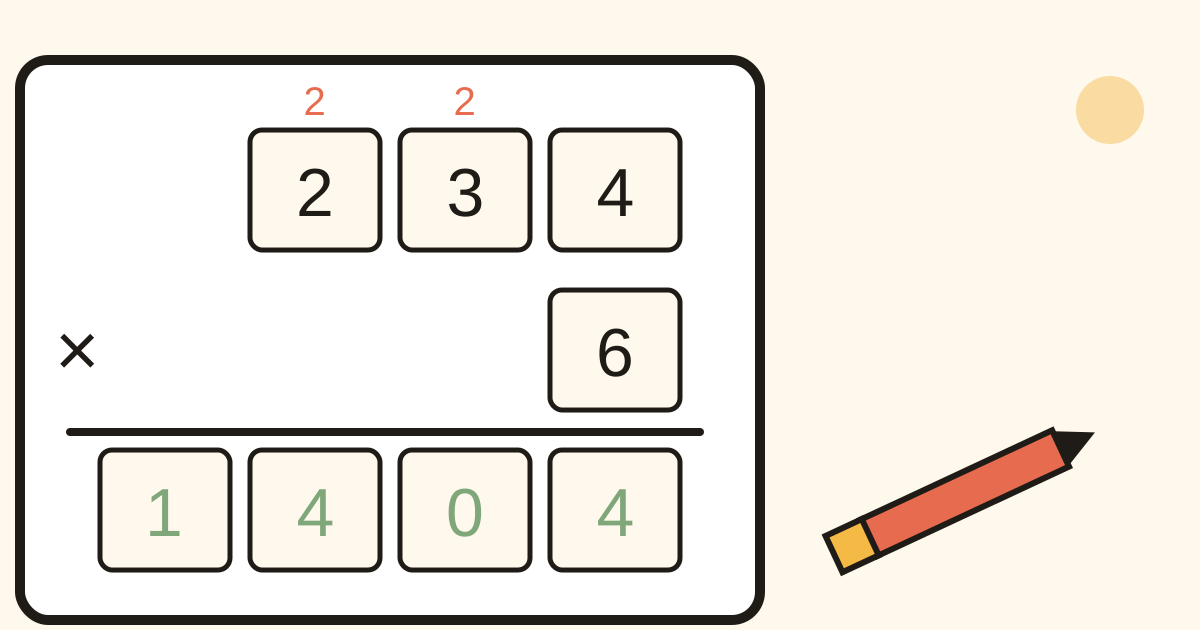
The simplest case has a single-digit multiplier, say 234 · 6. Work right to left, one place at a time: 6 · 4 = 24 — write the 4, carry the 2. Then 6 · 3 = 18, plus the carried 2 makes 20 — write the 0, carry the 2 onward. Finally 6 · 2 = 12, plus the carry makes 14, written out in full since no further digit follows. Result: 1,404.
What matters most here is pace: saying each column out loud ("six times four is twenty-four, write the four, carry the two") beats racing through it silently. Talking it through is the best error-catcher there is.
Two digits in the multiplier: partial products
Once the multiplier has two digits, the method changes in one crucial way: it produces two partial products that get added at the end. For 234 · 26, first multiply by the ones digit: 234 · 6 = 1,404. Then by the tens digit: 234 · 2 = 468 — but this partial product starts one place further left, because it's really 234 · 20, i.e. 4,680. That shifted zero isn't a formality; it's exactly what shows this row was worked in tens. Adding the two partial products, 1,404 + 4,680, gives 6,084 — the final answer.
This shift is where many children first have to actually understand rather than just copy the pattern: why does the second row move left? Saying out loud what's being multiplied — not "two times four" but "twenty times four hundred" — makes the shift explain itself.
The two most common mistakes
The most common mistake is exactly that missing shift: the second partial product gets written directly under the first instead of one place to the left, producing a result far too small. A quick size check catches it: 234 · 26 has to land around 200 · 25 = 5,000, not a three-digit number.
The second classic is a carry lost or misadded partway through a row — usually from working too fast, in the head, instead of on paper. The rule of thumb: the carry always gets written small above the next column, never just remembered. What's on paper can't be forgotten.
Three drills for home
Column multiplication needs one thing above all: lots of small, manageable problems rather than one big one.
- Estimate first: before each problem, guess roughly how big the answer should be — that makes shift errors visible immediately.
- The out-loud row: have your child talk through one problem completely out loud, naming every digit and every carry — mistakes almost always happen where the working goes silent.
- The cross-check: redo the same problem with the factors swapped (26 · 234 instead of 234 · 26) — matching answers means both were worked correctly.
Column multiplication isn't a new subject — it's a new order for two skills your child already has. Once times tables and carrying are solid, and the place-value shift has been explained out loud once, an intimidating-looking scheme turns into a method that works for any number, however large.