Alongside numbers and arithmetic, primary school runs a second, quieter curriculum strand: space and shape. It covers recognising and naming shapes, telling solids apart from flat figures, and seeing and drawing symmetry. It rarely gets practised at home — not because it doesn't matter, but because hardly anyone thinks to ask about it. Yet, just like times tables, this strand needs one thing above all: real things to handle.
The good news: space and shape can be practised almost in passing, with objects already in the house. No worksheet required to get started — just an open eye on the kitchen cupboard, the toy box and the bathroom mirror.
Recognising shapes is more than naming them
"It's a quadrilateral" isn't yet a complete answer. A square, a rectangle and a rhombus are all quadrilaterals — four corners, four sides — but they differ in their properties: a square has all four sides the same length and every angle a right angle. A rectangle only matches on the angles, not on all the sides. Primary-school children learn these properties through counting and comparing, not through memorised definitions.
One stubborn mix-up shows up constantly: a square rotated 45 degrees suddenly looks, to many children, like a different shape — "a diamond" — even though it's still a square, just turned. The counter-trick: cut a square out of paper and rotate it in front of your child. The sides stay the same length, the corners stay right angles — it is and remains a square, no matter how it's turned.
From flat shape to solid
A circle is flat, a sphere isn't — the distinction sounds obvious, but it causes real confusion early on, because both shapes are round and often get described with the same word. This is exactly where it helps to separate flat shapes (2D: circle, square, triangle, rectangle) from solids (3D: sphere, cube, cuboid, cylinder, cone) clearly — best done with real objects in hand, not only drawn on paper.
A simple matching game makes it concrete: a dice for the cube, a tin can for the cylinder, a ball for the sphere, a cereal box for the cuboid. Every solid has corners, edges and faces that can be counted — a cube has six faces, eight corners, twelve edges. A sphere has not a single edge. Counting instead of just looking makes the difference between solids tangible.
Seeing and folding symmetry
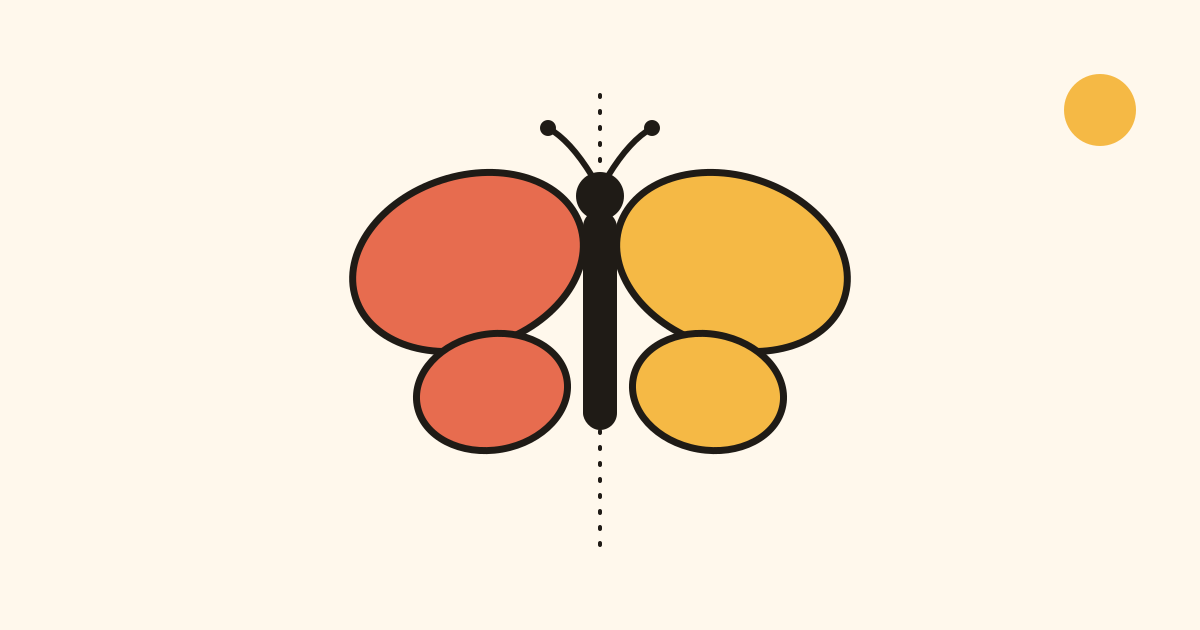
A shape is symmetric (more precisely: has line symmetry) if a line can be found that splits it into two exactly matching halves — fold along it, and both sides line up perfectly. The butterfly is the classic example, but symmetry is everywhere: in your own face, in many letters (A, M, T, W, X and Y are symmetric, F, G and J aren't), in road signs, in a four-leaf clover.
The best way in is still the classic ink-blot trick: drop paint on one half of a sheet, fold the sheet down the middle, press, unfold — a perfectly mirrored pattern appears on its own, no drawing skill required. After that, a search around the child's own room pays off: which toy is symmetric? Which isn't? A teddy bear roughly yes, a pair of scissors generally no.
The trick with a hand mirror
The most useful tool for symmetry is usually already in the bathroom: a small hand mirror. Held upright on a shape's suspected line of symmetry, the mirror instantly shows whether the reflected half matches the real one — if it does, the axis has been found. If it doesn't, the guessed line was wrong, and your child can keep looking.
This trick settles every guess immediately and without argument — the mirror doesn't lie. That makes it more honest than any "I think that fits" and turns symmetry from an abstract rule into a question a child can check for themselves.
Three exercises for home
Space and shape needs one thing above all: real objects, not just worksheets.
- The shape hunt: find and sort ten objects in the kitchen or at the playground — flat (2D) or solid (3D), round or angular. Say out loud why each shape belongs to which group.
- The letter check: use the hand mirror to test which capital letters in your child's own name are symmetric and which aren't — surprisingly gripping, because the result is almost never what's expected.
- The block build: build a tower of cubes and cuboids from building blocks while counting out loud: how many faces, corners and edges does each individual block have?
Space and shape can feel like a side note next to arithmetic — yet it trains the same skill needed later for reading charts, measuring area and volume, and even reading a map: looking closely before judging. Among our 39 primary-school practice topics, space and shape is its own area — following the same principle as everywhere at Talentists: touch and look first, name it second.