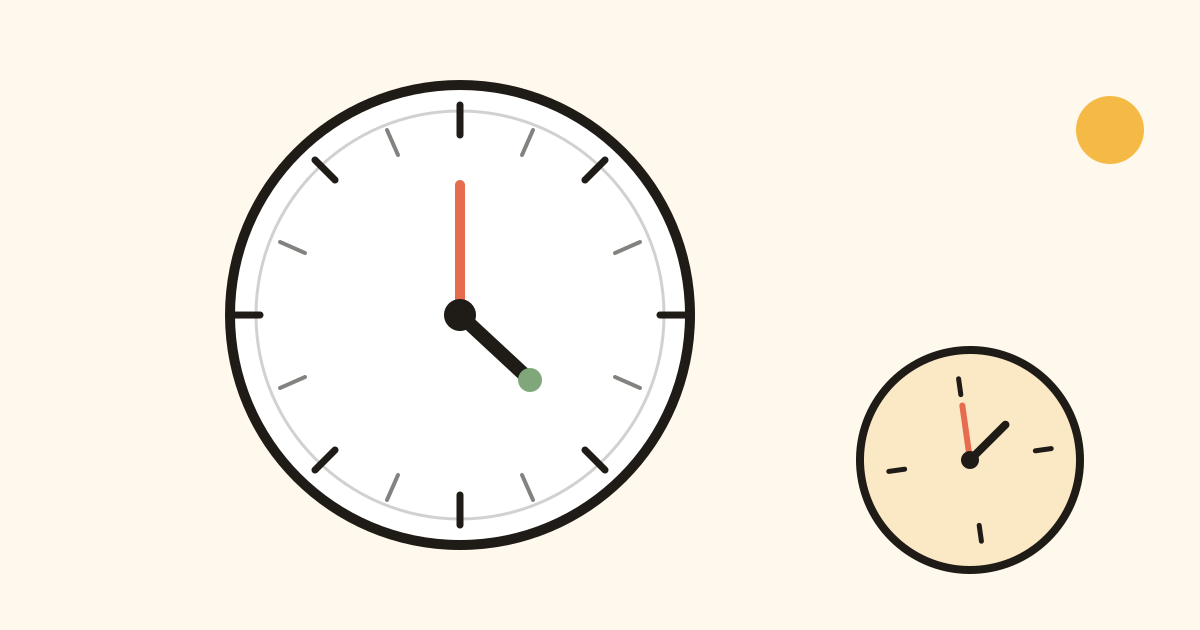
A contradiction many parents notice late: their child sees digital clocks constantly — on the stove, the phone, the car dashboard — yet still struggles to read a clock face with hands. That's not a step backward, it's logical: reading digital time is recognising numbers. Reading an analog clock is something entirely different — it requires translating a position on a circle into a number, twice at once, for both the hour and the minute hand.
That's exactly why it pays to tackle this topic in a fixed order rather than “just practising on the kitchen clock now and then”. With the right order, this takes a few manageable weeks — without it, the topic often drags across an entire school year, with frustration on both sides.
Step 1: full hours, only the hour hand counts
At the start, deliberately ignore the minute hand. Point to a clock where the minute hand sits exactly on the 12, and ask only: “Which number is the short hand pointing to?” That's the whole task — “It's 3 o'clock”, “It's 7 o'clock”. Only once that's solid does the next step come in.
A toy clock with movable hands helps more here than any worksheet: let your child set “4 o'clock”, “9 o'clock” themselves, rather than only reading. Setting the hands builds the concept more firmly than recognition alone.
Step 2: half and quarter hours
Next comes the half hour: minute hand on the 6, hour hand sitting between two numbers — and that's exactly the sticking point many children get wrong at first. At half past 3, the hour hand sits between 3 and 4, no longer exactly on the 3. Explain it this way: the hour hand creeps forward slowly the whole hour, unlike the minute hand, which jumps.
Then the quarter hours: minute hand on 3 (quarter past) and on 9 (quarter to). Important: introduce the everyday spoken phrasing first (“quarter past four”), and only afterwards — if at all wanted at this stage — the more precise digit format (4:15). The language used in daily life needs to click first.
Step 3: the 5-minute jumps
Now it gets counting-intensive: every number on the clock face stands for a 5-minute jump, but the number itself doesn't show the minute — it shows the position. The 3 means 15 minutes, not 3 minutes. That's the most common mix-up at this age.
One trick that reliably helps: count around the clock face together in steps of 5, pausing briefly at each number — “5, 10, 15, 20 …” all the way back to “60” at the 12. A child who can already recall the 5-times table securely (see our 10-minute times-table plan) has a clear edge here — the clock becomes an application of something already solid, not new material stacked on top.
Step 4: connecting analog and digital
Only once the analog clock is solid, connect it explicitly to the digital display your child already sees every day. Show both side by side: the kitchen clock with hands and the phone screen. “The little hand on the 4, the big hand on the 6 — that's the same as 4:30 on the phone.”
A second piece that's often forgotten: converting the 24-hour format. “14:00” on a train station display is the same as “2 o'clock” on the analog clock — just in the afternoon. The simple trick: for numbers above 12, just subtract 12.
Where telling time gets practised automatically
Telling time is one of the few math topics that can be practised almost incidentally in daily life, with no worksheet at all:
- Make the analog clock the official time-source: ask “What time is it?” instead of answering yourself — and consistently point at a clock with hands, not a phone.
- Have your child estimate time spans: “We need to leave at quarter past four. How many minutes do we have left?” — this links telling time directly to arithmetic.
- A child's own analog wristwatch or wall clock in their room creates more incidental contact than any weekend practice session.
As with times tables: short, regular contact beats one long practice session. And as with any new concept, patience pays off around the between-the-hours transition — that's where most children get stuck first, and it simply needs a few more weeks than the rest.