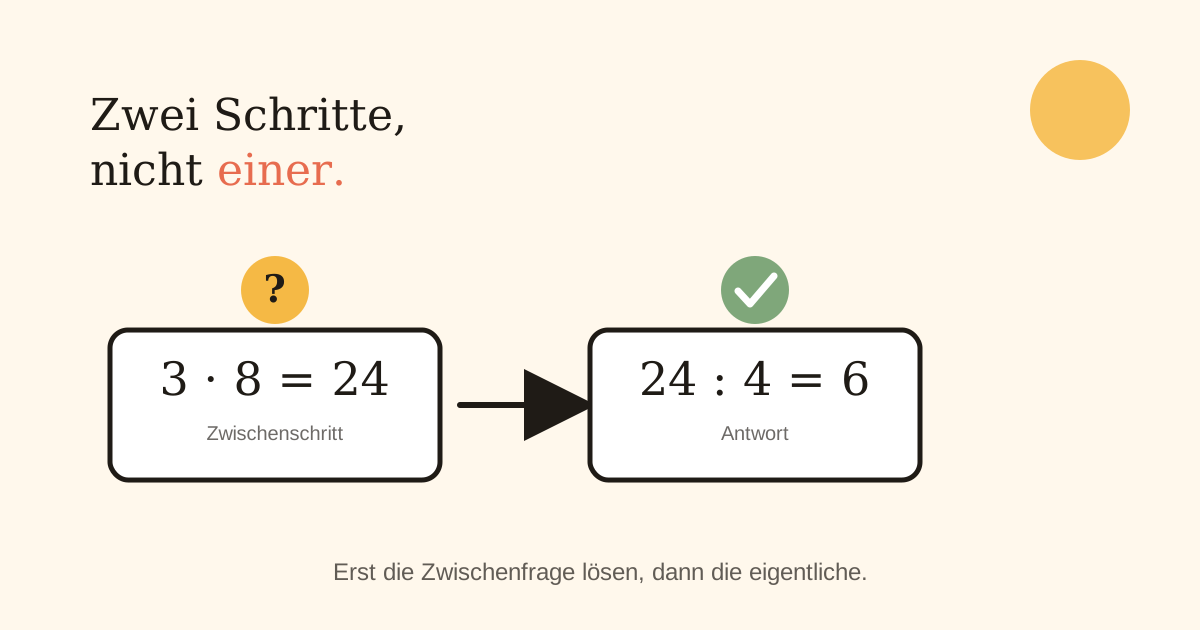
In a simple word problem, the right calculation almost writes itself: two numbers, one operation, done. Two-step problems look the same at first glance — and that's exactly what makes them hard. The question can't be answered directly, because a number is missing that first has to be worked out before the real calculation is even possible.
'Mum buys 3 packs of 8 biscuits and shares them equally among 4 children. How many biscuits does each child get?' There's no total number of biscuits stated in the problem — it first has to be found via 3 × 8 = 24, before 24 ÷ 4 = 6 gives the actual answer. Two calculations, one question.
How to spot a two-step problem
The most reliable sign: one of the numbers needed for the final calculation doesn't appear in the text at all. If the quantity being asked for isn't stated directly, only the building blocks it's made from, a step in between is needed. Children who miss this often try to use the numbers on hand straight away for the final question — and end up with a calculation that doesn't match the question.
The bridge: making the in-between question visible
The key trick is to say the hidden in-between question out loud and write it down before calculating anything: 'What do I need to know first, before I can answer the actual question?' For the biscuits, that in-between question is: 'How many biscuits are there in total?' Only once that's answered does the sharing among 4 children become calculable.
On paper, a simple in-between-result box helps: write the intermediate step on its own line, with its own result, before the second calculation begins. That visually separates the two thinking steps and stops both calculations from blurring into one.
A worked example, step by step
First read and mark the final quantity being asked for: 'How many biscuits does each child get?' Then check whether all the numbers for that calculation are already there — here, the total number of biscuits is missing. So solve the in-between question first: 3 packs times 8 biscuits gives 3 × 8 = 24 biscuits in total. Only now does the actual calculation follow: 24 biscuits divided by 4 children gives 24 ÷ 4 = 6 biscuits per child.
The last step, often skipped: write the answer as a full sentence — 'Each child gets 6 biscuits.' That forces a final check on whether the calculated number really is the one being asked for, and not just the in-between result.
The most common mistake
The classic mistake is confusing the in-between result with the final answer — stopping at 24 for the biscuits because that's the first number that 'looks right'. A second mistake: both operations get squashed into one, incorrect calculation, such as 3 × 8 ÷ 4 done in the wrong order, without being clear which number stands for what.
What your child can already build on
A child who already knows the four-step method for simple word problems — read, understand, calculate, check — only needs to add one step for two-step problems: formulate the in-between question between understanding and calculating. Everything else stays the same, just run twice in a row.
How to practise this at home in 10 minutes
A few drills that need no worksheet:
- Invent an everyday situation with two steps, such as shopping for change after buying two items, and have them name the in-between question out loud.
- When reading a problem aloud, pause before calculating and ask: 'What's still missing before you can answer the real question?'
- Deliberately extend a one-step problem by one step, turning '5 apples plus 3 apples' into sharing the total among several children.
- After solving each problem, have them say the answer as a full sentence, not just the number.
What Talentists does differently
Our worksheets deliberately don't pre-mark an in-between box on two-step problems — your child has to find the in-between question themselves, because that's exactly the skill needed in years 3 and 4, once problems stop coming with scaffolding.