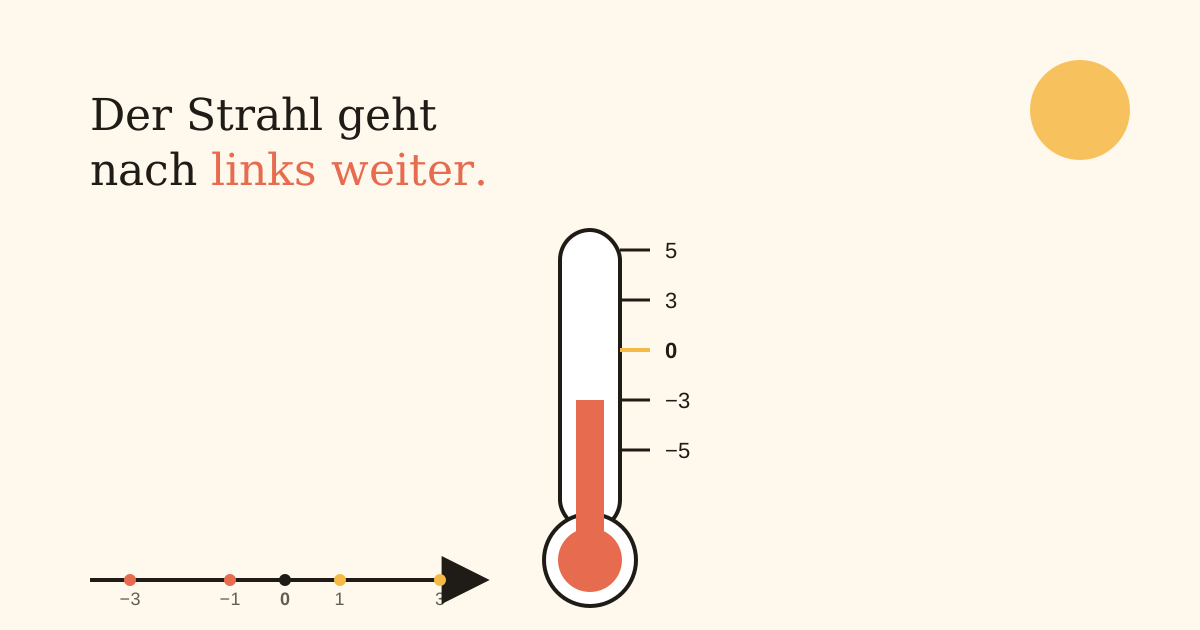
Minus 3 degrees is colder than minus 1 degree — for a child who has just learned that 3 is bigger than 1, that feels backwards at first. This is exactly where many kids trip up on their first encounter with negative numbers: the familiar rule 'bigger number means more' suddenly seems to run the other way.
The fix doesn't need a new concept — just an extension of a familiar one: taking the number line, which has so far stopped at 0, and simply drawing it further to the left.
The number line doesn't stop at 0
So far, your child has only known the number line to the right of 0: 1, 2, 3 and so on, each number bigger than the one before. Negative numbers are nothing more than that same number line, mirrored to the left: −1, −2, −3. And the rule stays the same — the further right a number sits, the bigger it is. −1 sits further right than −3, so −1 is bigger than −3, just as −1 degree is warmer than −3 degrees.
A thermometer turns the number line upright
A thermometer is a number line, just standing up instead of lying down, with 0 in the middle instead of at the far left. Up means warmer, down means colder — exactly the way right means bigger and left means smaller on the horizontal number line. Once a child has seen that connection, any temperature reading maps directly onto the familiar number line, with no new rule to learn.
Working out temperature differences
How many degrees lie between −4 degrees at night and 3 degrees at midday? Counted along the number line: from −4 to 0 is 4 steps, from 0 to 3 is another 3 steps, 7 degrees difference in total. This counting strategy is more reliable than a memorized rule, because it shows visibly why the two temperatures end up being added rather than subtracted, even though they carry different signs.
Where negative numbers show up in everyday life
It's not just temperature: a bank balance of −20 euros means 20 euros of debt, floor −1 in a lift sits below the ground floor, an elevation of −3 metres sits below sea level. In all three cases the same idea as the thermometer applies: 0 marks a fixed reference point, and negative numbers sit on the other side of it.
The most common mistake
The classic mistake is ignoring the minus sign and only comparing the number behind it: −5 then gets mistakenly treated as bigger than −2, because 5 is bigger than 2. The number line corrects that immediately, the moment counting actually happens instead of just comparing digits.
What your child can already build on
A child who can already use the number line confidently to compare numbers and count distances already holds the real tool — negative numbers just ask for that same line to be extended past 0, instead of stopping there.
How to practise this at home in 10 minutes
A few drills that need no worksheet:
- Check the outdoor temperature or a weather app together and place it: warmer or colder than yesterday?
- Name two temperatures, say −2 degrees and 5 degrees, and have them count the difference along an imagined number line.
- Look for floors below 0 in a lift or a car park sign and have them explain what it means.
- Sketch a simple number line with negative and positive numbers and have them place numbers on it.
What Talentists does differently
Our worksheets introduce negative numbers through the temperature scale instead of an abstract rule, because a thermometer is something a child already knows and can read at a glance — the calculation rule then follows from the picture, not the other way round.