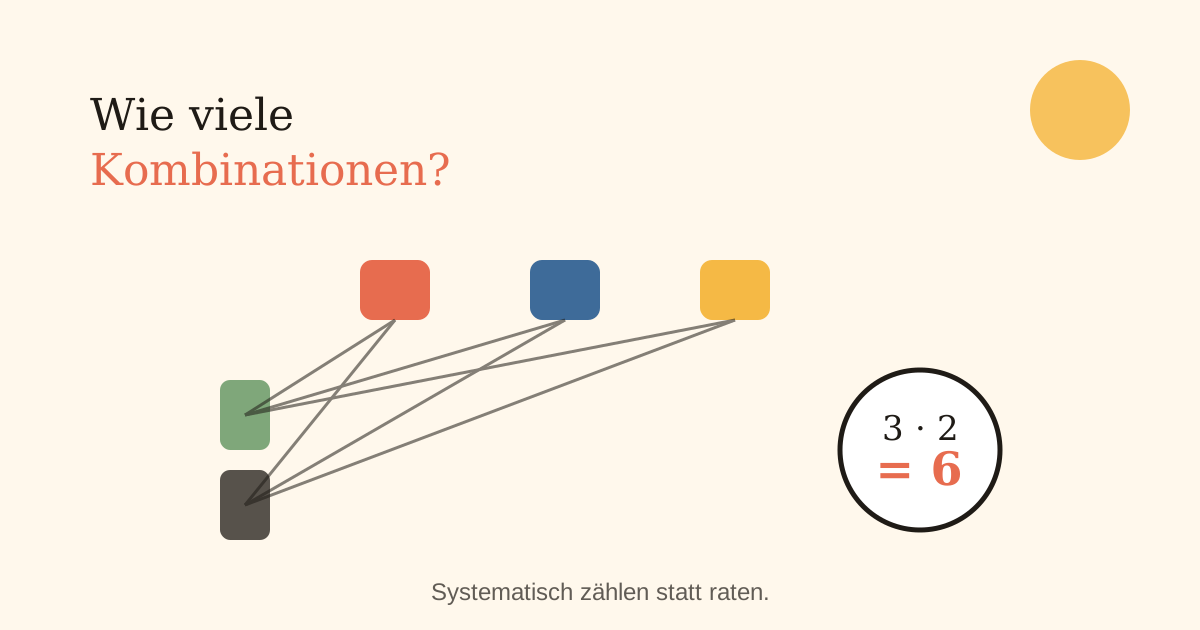
'How many different outfits can you put together from 3 T-shirts and 2 pairs of trousers?' is one of the questions children guess wrong most often — not because the maths is hard, but because the obvious-looking answer, 3 plus 2 equals 5, is completely off. The right answer is 3 × 2 = 6, because every one of the 3 T-shirts can be paired with either of the 2 pairs of trousers.
Combinatorics sounds like a big word, but in primary school it's exactly this: systematically counting how many possibilities exist when several things are combined — without counting any combination twice or missing one.
The classic: combining clothes
The T-shirt-and-trousers example works so well because it's tangible: put 3 T-shirts and 2 pairs of trousers on the table, or draw them. Every T-shirt can be worn with every pair of trousers — T-shirt 1 with trousers 1, T-shirt 1 with trousers 2, T-shirt 2 with trousers 1, and so on. Anyone who actually goes through every pair ends up at 6 automatically, without needing the formula in their head.
The system: a table instead of guessing
The reason many children slip up when listing combinations is a lack of order — one combination gets missed, another gets written down twice. A grid table fixes this: T-shirts along one row, trousers down one column, and every cell of the table stands for exactly one combination. Working through the table cell by cell means no combination can be forgotten and none counted twice.
Why multiplying, not adding
The 'add them' mistake happens because it feels like two groups are simply being put together. What's actually happening is different: every single T-shirt comes with 2 possible pairs of trousers — the same structure as times tables, where 3 groups of 2 things together make 3 × 2. Once a child has counted the grid table once, this structure usually becomes visible on its own: 3 rows of 2 cells each is simply 3 × 2 cells.
The most common mistake
The first typical mistake is adding instead of multiplying, as described above. The second is listing combinations without a table or system — combinations then get missed or written down twice, and the result is wrong even when the underlying idea was understood.
What your child can already build on
A child who's solid on times tables already has the real tool for this: primary-school combinatorics is, at its core, applied multiplication — just with objects instead of pure numbers. And a child who can already judge whether an outcome is 'certain, possible or impossible' brings exactly the systematic thinking needed to list every combination completely.
How to practise this at home in 10 minutes
A few drills that need no worksheet:
- Pick 2 or 3 tops and 2 pairs of trousers from the real wardrobe and actually lay out every outfit side by side.
- Play through an ice-cream-shop example: 3 flavours and 2 cone types — how many different ice creams are there?
- Draw a grid table on paper and fill it in together, cell by cell.
- Have them guess the count first, then check it against the table and compare whether the guess was right.
What Talentists does differently
Our worksheets deliberately have children solve combination problems via a table first rather than a formula, because working through it systematically is the way of thinking that still holds up once no formula is on hand.