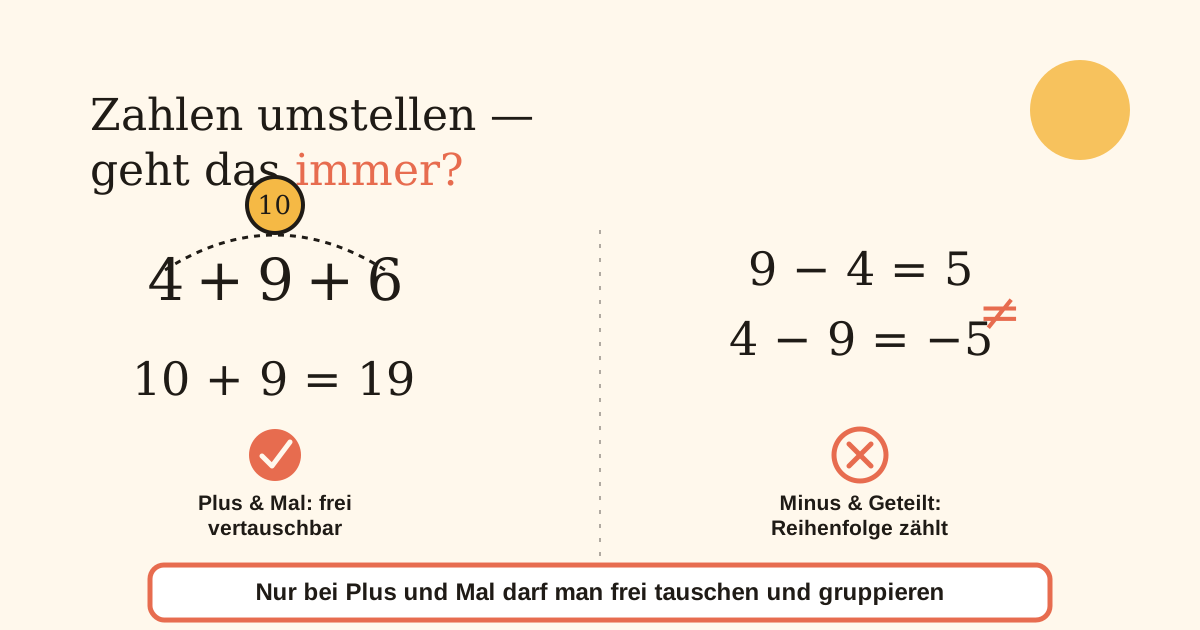
From grade 3 onward, a new phrase shows up in the maths book: using a shortcut, or "number trick". It isn't a new method — it's permission to stop working through a calculation strictly left to right, and instead reorder or regroup the numbers so the maths gets easier in your head, with the result staying exactly the same.
With 4 + 9 + 6, it pays to add 4 and 6 first, because that makes a round 10: 10 + 9 = 19, with nothing to memorise and no extra step. But that freedom to reorder and regroup numbers only applies to addition and multiplication. With subtraction and division, the exact same move produces a wrong answer — and that's exactly where many children trip up the first time they try applying the new trick everywhere.
The rule in one sentence
Two laws sit behind every number trick like this. The commutative law lets two numbers in a pure addition or multiplication swap places without changing the result: 4 + 9 = 9 + 4, and likewise 3 × 7 = 7 × 3. That doesn't hold for subtraction and division — 9 − 4 and 4 − 9 are two completely different results, just as 20 ÷ 4 and 4 ÷ 20 are.
The associative law adds that in a chain of pure addition or pure multiplication, it's free to choose which two numbers get combined first: (4 + 6) + 9 is the same as 4 + (6 + 9). In a chain that includes subtraction, that only works if every number carries its own sign along with it.
Where the mistake comes from
These shortcuts almost never fail at the arithmetic itself — they fail because the new freedom from addition quietly gets carried over to subtraction.
- A child carries the swap freedom just learned for addition straight over to subtraction, accidentally computes 4 − 9 instead of 9 − 4, and lands on a wrong answer because both numbers look interchangeable on the page.
- In a mixed chain like 12 − 5 + 3, the minus sign gets dropped during reordering: 5 and 3 get combined as if both were positive, without the 5 being carried along as "minus 5", turning the correct answer of 10 into a mistaken 12 − 8 = 4.
- With multiplication, the swap itself is done correctly, but the new order isn't actually put to use — a child reorders without checking whether one of the new pairings is genuinely easier, say because it makes a 10 or a well-known times-table fact.
- The shortcut only gets recognised when a problem looks exactly like the ones in the workbook. Once the same calculation is buried inside a word problem, it gets worked strictly left to right even though the same shortcut would still apply.
What your child can already build on
A child who already knows swap facts from the times tables — 3 × 8 and 8 × 3 give the same answer — has already experienced the core idea of swapping. A number trick with three or more numbers is the same idea, just with more numbers at once.
Sorting objects also works as a mental image: whether a handful of sweets gets counted by colour first or by size first, the total stays the same. Taking away is different — removing the red ones first and counting what's left gives a different picture than removing the big ones first. That distinction between reordering and taking away is exactly the core of the rule.
How to practise this at home in 10 minutes
A few drills that need no worksheet:
- Set three addition problems with matching ten-partners (e.g. 7 + 8 + 3, 6 + 9 + 4) and have your child say out loud which two numbers they add first and why.
- For a single subtraction problem like 9 − 4, ask directly: "is 4 − 9 the same?" and show why not with real objects — taking 4 away from 9 buttons gives a different picture than laying out 4 buttons and trying to take 9 away.
- Lay out a mixed chain like 12 − 5 + 3 using coloured cards that show the number AND its sign, so it becomes visible that "− 5" travels along as one fixed package whenever the order changes.
- With three multiplication numbers like 2 × 7 × 5, have your child search for the easiest order (2 × 5 = 10 first) and compare it with the original order — same result, less mental effort.
What Talentists does differently
Our grade 3–4 worksheets deliberately mix number-trick problems with "traps" where the same reordering is not allowed with subtraction, so your child learns the real boundary of the rule instead of applying it blindly to every problem. A five-minute assessment shows whether that distinction has already landed, and the worksheet starts exactly there. Stuck on one specific problem? A QR code gives a free explanation right next to it, no account needed.