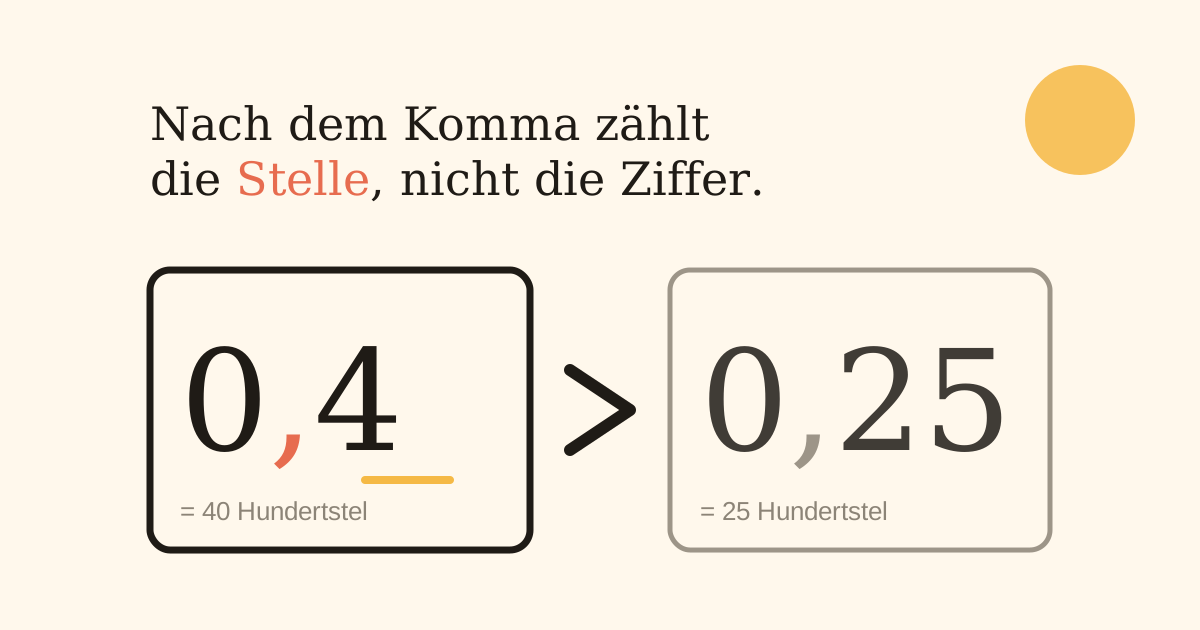
"Which is bigger, 0.4 or 0.25?" Plenty of children answer with total confidence: 0.25, because 25 is bigger than 4. The mistake sounds trivial, but it's surprisingly stubborn — and it's one of the most common stumbling blocks once decimals show up in grade 4.
The good news: the misunderstanding usually clears up in a few minutes, once it's clear what's actually happening after the decimal point.
What's actually behind the decimal point
Before the decimal point sits a multiple of ten — tens, ones. After the point, the same principle just keeps going, in reverse: the first digit counts tenths, the second hundredths. 0.4 means four tenths, also written as 4/10. 0.25 means twenty-five hundredths, so 25/100.
To compare two decimals fairly, they need to be brought to the same number of decimal places: 0.4 is forty hundredths, so 40/100 — and forty hundredths is more than twenty-five hundredths. So 0.4 is bigger than 0.25, even though the single digit 4 looks smaller than 25.
Where the mistake comes from
The comparison error isn't a sign of weak arithmetic — it's a rule carried over from somewhere else. With whole numbers, it's entirely correct that more digits and higher digits mean a bigger number. That rule only works for decimals once both numbers are brought to the same number of decimal places first — and that in-between step is exactly what most children are still missing.
- 0.25 is assumed to be bigger than 0.4, because 25 is bigger than 4 — without accounting for place value.
- 0.5 and 0.50 are treated as different-sized numbers, even though they're identical.
- An extra zero after the point is read as "more value," for instance with 0.30 versus 0.3.
- When calculating, the decimal point simply gets ignored and the numbers are treated as whole numbers.
What your child can already build on
Money is the fastest bridge: €0.40 is 40 cents, €0.25 is 25 cents — and every child who's ever paid at a shop knows that 40 cents is more than 25 cents. The trick: translating decimals into cents or centimetres makes the comparison concrete again, instead of juggling decimal digits in the abstract.
Lengths work just as well: 0.4 m is 40 cm, 0.25 m is 25 cm. Once a unit is attached, the mistake usually disappears on its own — because two abstract numbers become two very concrete quantities that are easy to compare.
How to practise this at home in 10 minutes
A few concrete drills that need no worksheet:
- Write down two decimals and have your child translate them into cents or centimetres first, before comparing.
- Fill in missing zeros so both numbers have the same number of decimal places — 0.4 becomes 0.40 — and the comparison gets easy again.
- Work with a number line between 0 and 1 and have your child mark the number on it, instead of only working with digits.
- Ask everyday questions like "Which is more: half a chocolate bar or 0.4 of one?" — a real-world hook beats plain number drills.
What Talentists does differently
Our grade-4 worksheets deliberately build the move into decimals through money and length before comparing decimal digits in the abstract. A five-minute assessment shows whether your child already distinguishes tenths from hundredths reliably or is still thinking in whole-number terms, and the worksheet starts exactly there. Stuck on one specific problem? A QR code gives a free explanation right next to it, no account needed.