A pictogram made of apple icons looks, at first glance, like the simplest chart there is — far simpler than a bar chart with labelled axes. That's exactly the trap: without reading the key first, a child just counts the icons and treats that count as the answer. But if the key says 'one icon = 2 children', every count taken that way is wrong.
A pictogram isn't a picture to count — it's a multiplication problem in disguise. Reading the key first uses the same idea as reading a bar chart — except here it's not bar height but the number of icons times the key's value that gets calculated.
The key first, not the symbols
Every pictogram has a small line, usually at the edge: '= 2 children' or '= 5 books'. That key sets how much a single icon is worth — and it changes from one pictogram to the next. The habit worth building: read the key first, say out loud what one icon stands for, and only then start counting icons.
Half icons mean half the value
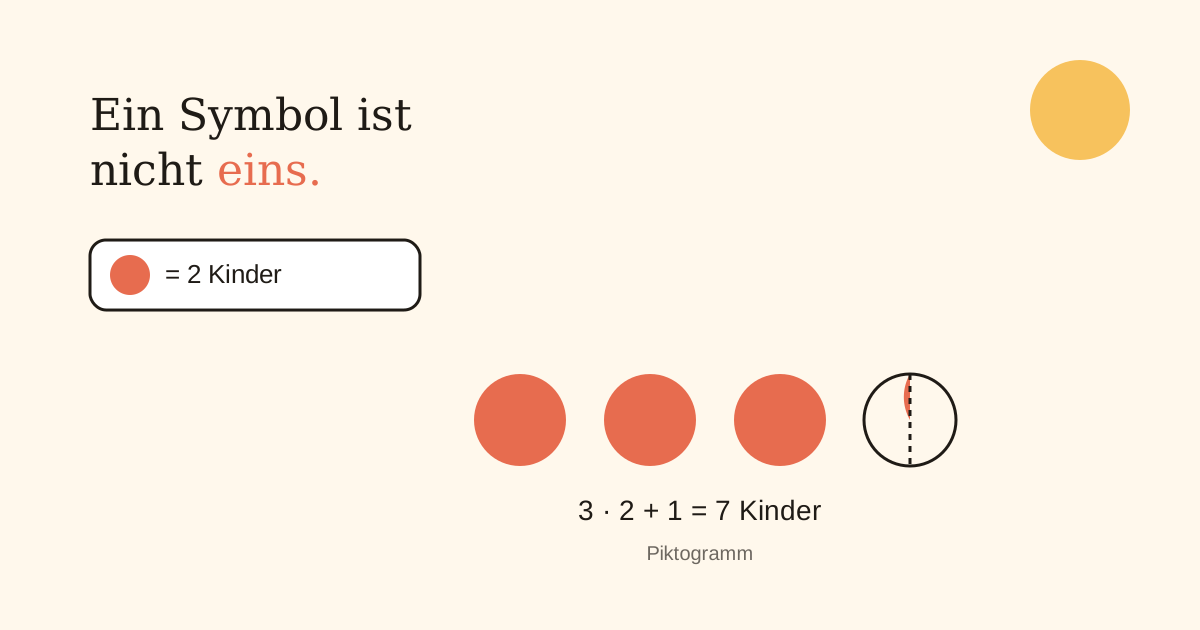
If one icon stands for 2 children, then a half, cut-off icon stands for 1 child — not 'roughly' or 'a bit less'. Three full apple icons and one half icon, with a key of '= 2 children', give 3 × 2 + 1 = 7 children. The half icon is a genuine piece of the calculation, not a drawing mistake.
From symbol to calculation
To find the count behind a row of symbols, multiply the number of symbols by the key's value: 4 symbols at '= 5 points' gives 4 × 5 = 20 points. Going the other way — given a number, drawing the matching symbols — means dividing: 30 points at '= 5 points per symbol' is 30 ÷ 5 = 6 symbols. Reading and drawing a pictogram are the same calculation, just run in opposite directions.
Comparison questions: the real test question
Just like a bar chart, the question is rarely a single number — it's a comparison: how many more children like dogs than cats? Both rows have to be translated into real numbers first before subtracting; comparing the icon counts alone only works if the key's value is 1.
The most common mistake
The classic mistake is counting the icons like tally marks and skipping the key — especially when an earlier chart had a key value of 1 and the next one suddenly has 2 or 5. A second mistake: a half icon gets ignored or counted as a whole one, instead of as half the key's value.
What your child can already build on
A child who can already read a bar chart and bundle a tally chart into groups of five has already grasped the real idea: a symbol, a bar or a bundle of tallies rarely stands for exactly 1 — it stands for a fixed value that has to be looked up first. Pictograms just apply that same idea with a picture instead of a number.
How to practise this at home in 10 minutes
A few drills that need no worksheet:
- Invent a simple pictogram together — pets in the family or among friends — and set a key of '= 2'.
- Find a pictogram in a nonfiction book or magazine and read the key out loud together first.
- Given a number, have them draw the matching count of symbols, including a half symbol.
- Compare two rows of a pictogram: how much more or less is one than the other?
What Talentists does differently
Our worksheets deliberately vary the key's value from problem to problem instead of always leaving it at 1, because that variation is exactly what reveals whether a child is really reading the key or just counting symbols.