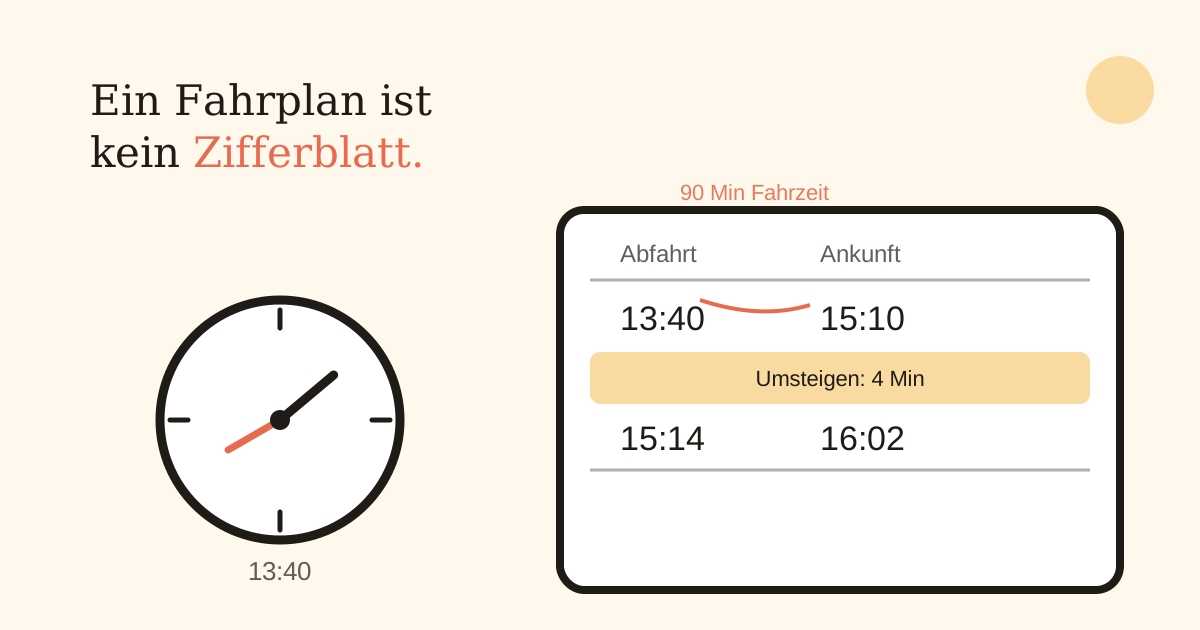
Your child might already read a clock confidently — a real timetable still asks for more: several columns, several times at once, and usually 24-hour notation instead of the familiar 12 hours on a clock face. Getting through it takes the same skill as working out a time span — just with real, messy everyday numbers instead of tidy textbook ones.
Three skills meet in a single timetable: translating times between the two notations, telling departure and arrival apart, and working out the duration from the two.
Translating 24-hour notation
Timetables almost always show times in 24-hour notation: 13:45 instead of 'quarter to two in the afternoon'. The trick for translating: for anything over 12, just subtract 12 and add 'in the afternoon/evening' — 13:45 becomes 1:45 in the afternoon, 19:20 becomes 7:20 in the evening. Under 12, the time stays the same, just in the morning.
Departure, arrival, duration
Every row of a timetable has at least two columns: departure time and arrival time. The journey's duration is the difference between the two — exactly the same calculation as working out a time span between two clock times. A train that leaves at 13:40 and arrives at 15:10 takes 90 minutes, no matter how odd the times look at first glance.
Transferring: combining two timetables
A transfer brings two timetables together: the first train's arrival time has to fall before the second one's departure time — with enough time left in between to actually change trains. If the first train arrives at 15:10 and the second leaves at 15:14, that's only 4 minutes — tight, but workable. That's how two separate clock times turn into a real travel plan.
The most common mistake
The classic mistake: mixing up the departure and arrival columns, so the journey time gets calculated from the wrong time. The second common mistake happens with the 24-hour conversion: 19:20 gets read as '9:20' instead of '7:20 in the evening', because subtracting the 12 gets forgotten.
What your child can already build on
A child who already reads clock times confidently and can work out a time span between two clock times already has the actual calculation under control — a timetable just asks for that same calculation to be applied several times in a row, with real, sometimes awkward numbers.
How to practise this at home in 10 minutes
A few drills that need no worksheet:
- Look up a real local bus or train timetable and plan a route together.
- Say a time in 24-hour notation and have them translate it into everyday speech, and back again.
- Before an actual trip, estimate the journey time first, then check it against the timetable.
- Combine two timetables: is the transfer time between the bus and the train actually enough?
What Talentists does differently
Our worksheets work with real timetables instead of tidy example numbers, because a timetable with awkward times is exactly where a half-understood rule falls apart — and a genuinely understood one holds up.