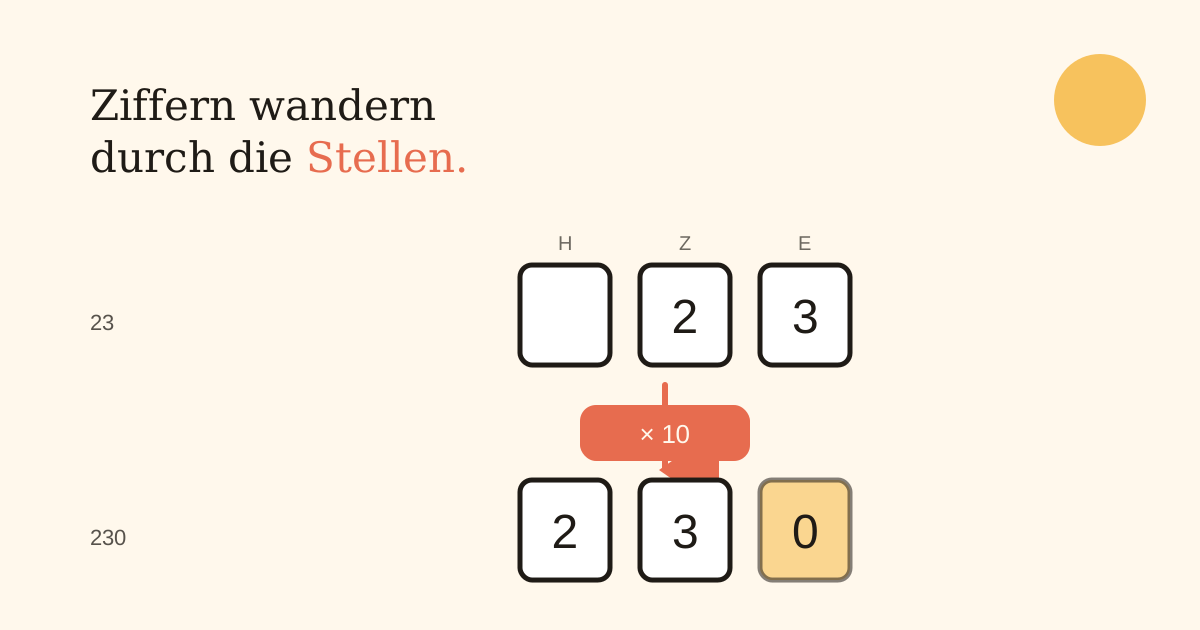
23 times 10 is 230 — add a zero, done. The trick even holds up, as long as you're only working with whole numbers. That's exactly what makes it dangerous: the moment a decimal shows up, the rule breaks down, and your child has no backup plan, because they never understood what that extra zero actually meant.
What's really happening when you multiply and divide by 10, 100 and 1000 is simpler than the shortcut — and it works for every number, decimal point or not.
What's really happening: digits move through the place values
Every number is built from place values — ones, tens, hundreds, thousands. Multiplying by 10 shifts every digit exactly one place to the left: the 3 in the ones place becomes a 3 in the tens place, the 2 in the tens place becomes a 2 in the hundreds place. The ones place, now empty, gets a 0 — not because a zero was 'tacked on', but because there's simply no digit left standing there.
×100 and ×1000 don't need a new rule
×100 shifts two places, ×1000 shifts three — the same movement, just repeated. 23 becomes 2300 at ×100, and 23000 at ×1000. Once a child understands the shift through the place-value system, there's no need to memorize three separate rules — one idea, applied more than once.
Where 'just add a zero' falls apart
2.3 times 10 breaks the shortcut instantly: 'add a zero' would give 2.30 — but 2.3 times 10 is 23. The real rule still holds: every digit shifts one place to the left, the decimal point stays put while the digits move past it. 2.3 becomes 23.0, which is 23.
Dividing is the reverse
Dividing by 10 shifts the same number of places, just the other way: every digit moves one place to the right. 230 divided by 10 becomes 23; 23 divided by 10 becomes 2.3 — if there aren't enough digits left, a decimal point appears. That's not a mistake, that's the answer.
The most common mistake
Children who've only learned the zero-rule often apply it backwards or blindly to every problem: 230 divided by 10 becomes 'add a zero' instead of remove one, or a number that already ends in 0 picks up one zero too many or too few when multiplied, because nobody is tracking which digit is actually moving where.
What your child can already build on
A child who already knows the place-value chart for big numbers already has the real tool for this: the exact same columns — ones, tens, hundreds — are what the digits move through here. And a child who can do written multiplication is already shifting digits by one place in every row of the calculation.
How to practise this at home in 10 minutes
A few drills that need no worksheet:
- Say a two-digit number and have them work out ×10, ×100 and ×1000 in their head.
- Read out a decimal price from a supermarket flyer and multiply it by 10 — what would 10 packs cost?
- Say a number like 4500 and have them divide it by 10, by 100 and by 1000.
- Ask them to explain out loud why 2.3 times 10 isn't 2.30, but 23.
What Talentists does differently
Our worksheets don't just ask for the answer — they ask which digit moved where, for decimals just as much as whole numbers, because that's the difference between a memorized trick and a principle that actually holds up.