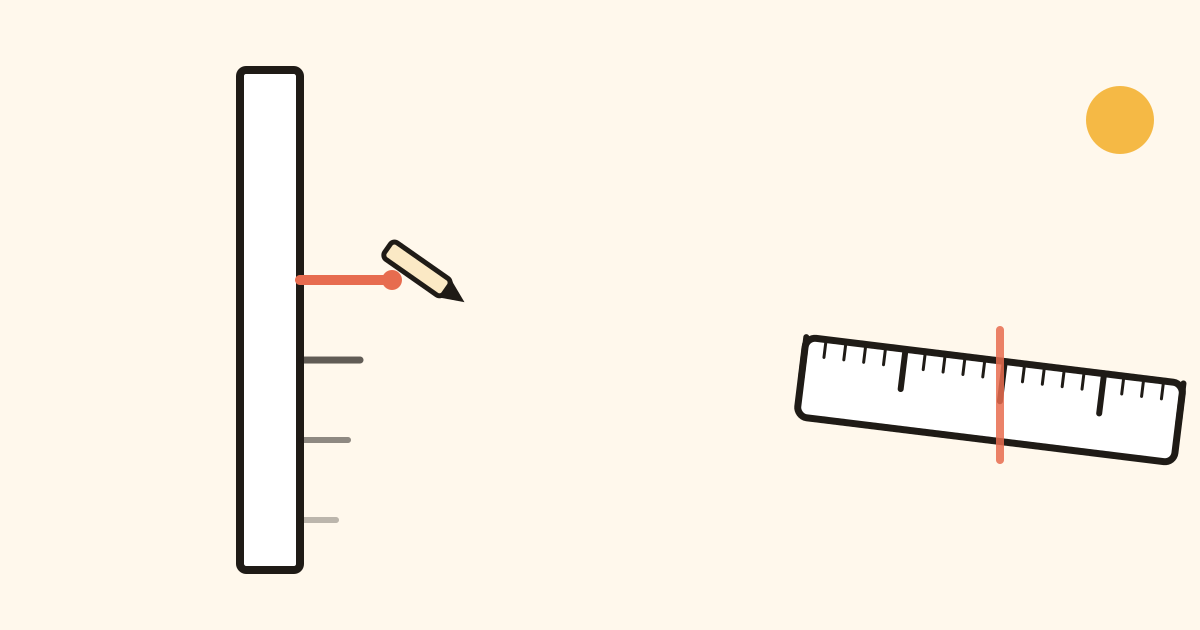
Many homes carry a quiet record of time that nobody writes down on purpose: the pencil marks on a door frame where each child's height climbs year by year. Those very marks are the best way into one of grade 2's underrated topics — estimating and measuring length.
The real difficulty rarely lies in the measuring itself. Holding a ruler correctly is learned quickly. The harder question comes before that: is the tabletop roughly 70 centimetres wide, or 70 metres? Children without an inner feel for scale will cheerfully guess either — and that feel for scale can be built quite deliberately.
Comparing first, measuring precisely second
The curriculum deliberately moves in small steps, and the order pays off at home too. It starts with direct comparison and no numbers at all: lay two pencils side by side and ask which is longer. No ruler, no tape measure — just looking.
Only after that come non-standard units: how many hand-spans wide is the table? How many steps long is the hallway? It sounds like a detour, but it's the heart of the matter — children experience first-hand that a length only becomes a number once there's something to compare it to. Once that's solid, the standardised units centimetres and metres follow naturally — they're simply a comparison everyone has agreed on.
Cm or m? The anchor trick
The question “centimetres or metres?” isn't solved by memorising a rule, but by a handful of fixed reference sizes in the head — anchors that let any new length be placed immediately.
For centimetres, a finger works well: from one knuckle to the next is roughly 2 to 3 centimetres, the width of the little finger about 1 centimetre. A wax crayon is around 10 centimetres long, an exercise book about 21 centimetres tall. For metres, a glance at the door is enough: a room door is roughly 2 metres tall — exactly the frame the pencil marks climb up. An adult's big step comes close to a metre.
These anchors aren't rote facts for a test — they're a lifelong tool. Anyone who knows a door is about 2 metres tall spots instantly that an “8-metre-tall cupboard” must be a mistake, before even doing the sum.
The most common mistake: not starting at zero
The classic measuring error doesn't happen in the head, it happens in the hand: many children line up the edge of the ruler, not the zero mark. On rulers with a wide border before the zero, the result is then systematically off — usually one or two centimetres too much.
The fix is simple and worth doing before measuring even starts: have your child point a finger at the zero first, then place the ruler. A second glance pays off at the reading end too — the number right at the edge of the object counts, not the nearest big digit.
A second trap waits at conversion: “1 metre 20” often gets written as “1.2 m” or plain “120” with no unit, when “1.20 m” or “120 cm” are correct. Just as with money, it helps to say it separately first — “one metre and twenty centimetres” — and derive the written form together afterwards.
Three everyday drills, no ruler homework needed
Measuring length needs no worksheet — everyday life supplies plenty of chances:
- Extend the door-frame marks: draw the next line for the current height and have your child guess how many centimetres it's grown since the last mark.
- The furniture check: before the next furniture purchase, measure together with a tape measure whether the new desk will even fit through the bedroom door.
- The estimate bet: guess before measuring (“how long do you think the kitchen is?”), then check. The gap between guess and result is the real learning moment, not the measurement itself.
Length is one of the few grade-2 topics that never leaves the kitchen table — every home is full of chances to estimate and check. Using them hands your child, almost incidentally, exactly the feel for scale that later makes the difference in rough estimates and word problems involving length.