A cinema ticket showing "Row 5, Seat C" is something every child reads without a second thought. The very same principle sits behind the grid that shows up in years 3 and 4 on maps, seating plans and game boards — except there it's usually called column and row rather than row and seat, and the order is exactly reversed from the cinema ticket. That's exactly where many children trip up.
How a grid is built
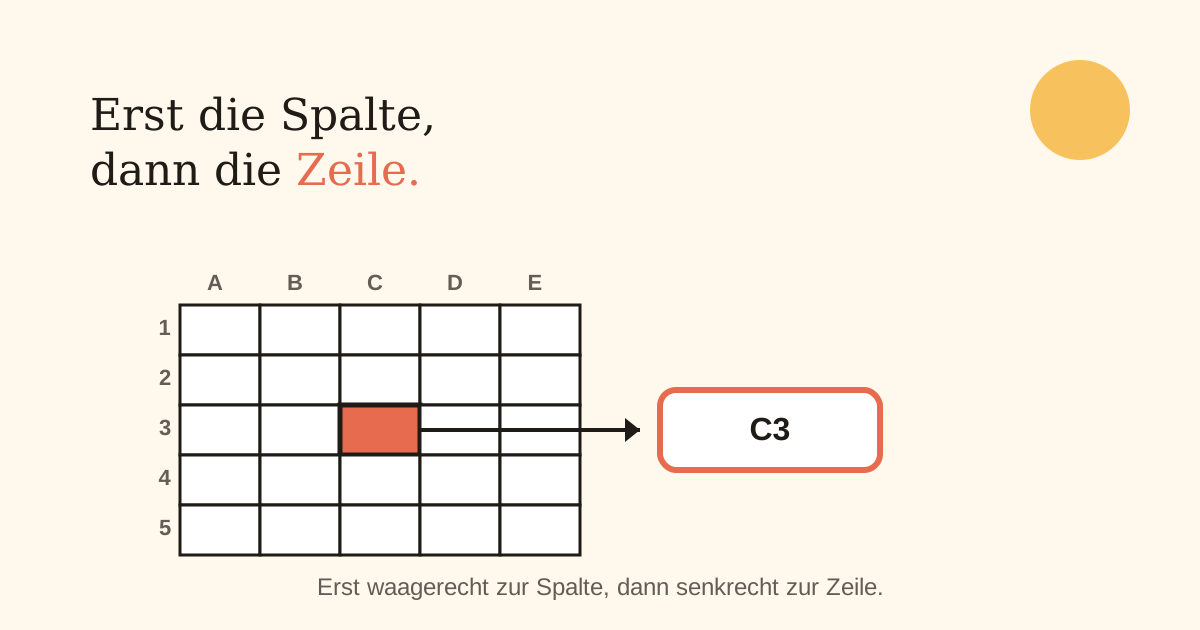
A grid divides an area into columns and rows. Columns run left to right and are usually marked with letters (A, B, C, …); rows run top to bottom and are marked with numbers (1, 2, 3, …). A cell is named uniquely by combining both — for example "C4".
The fixed rule: the letter first, then the number — the column (horizontal) first, then the row (vertical). This order is a convention, not a calculation rule, but it needs to sit just as firmly as one, otherwise C4 gets confused with 4C and a completely different cell gets found.
Where the mistake comes from
The core idea — finding a cell from two pieces of information — clicks quickly for most children. The mistakes are almost always in the detail.
- Column and row get swapped — instead of "horizontal first, then vertical", the search starts up or down first, because the cinema-ticket pattern (row first) gets applied in the wrong direction.
- Counting starts from the wrong corner — some grids start top-left, others bottom-left; without checking the corner first, the finger lands on the wrong cell.
- Lines get counted instead of cells — some tasks mean a point at an intersection, others a whole square; mixing the two up shifts the answer by exactly one cell.
- A cell gets skipped or counted twice while reading, because the finger doesn't trace along, and the eyes just estimate instead.
What your child can already build on
A child who can already reliably read values from a table with row and column headers — from a tally chart or a bar chart, say — already knows the core principle: two pieces of information together point to exactly one cell. What's new with a grid is only that the column header is a letter instead of a word, and that the fixed column-before-row order has to be kept.
Systematic counting in rows, already practised when reading charts or counting 3D shapes, helps directly too: at its core, a grid is nothing more than a table that holds cells on a drawing instead of numbers.
How to practise this at home in 10 minutes
A few drills that need no worksheet:
- Play Battleship — the game trains column-before-row reading almost by accident, with instant feedback on whether the right cell was hit.
- Grab a map with a grid reference index (a travel guide works well) and find a street together using its grid reference.
- Name squares on a chessboard — a1, e4 — and take turns calling one out and finding it.
- Draw an empty grid on squared paper, label columns with letters and rows with numbers, and have your child draw symbols on the cells you call out.
What Talentists does differently
Our grade 3–4 worksheets introduce the grid through a familiar context like a seating plan or a treasure map first, before abstract practice grids, and drill the column-before-row order explicitly as a fixed rule instead of assuming it along the way.