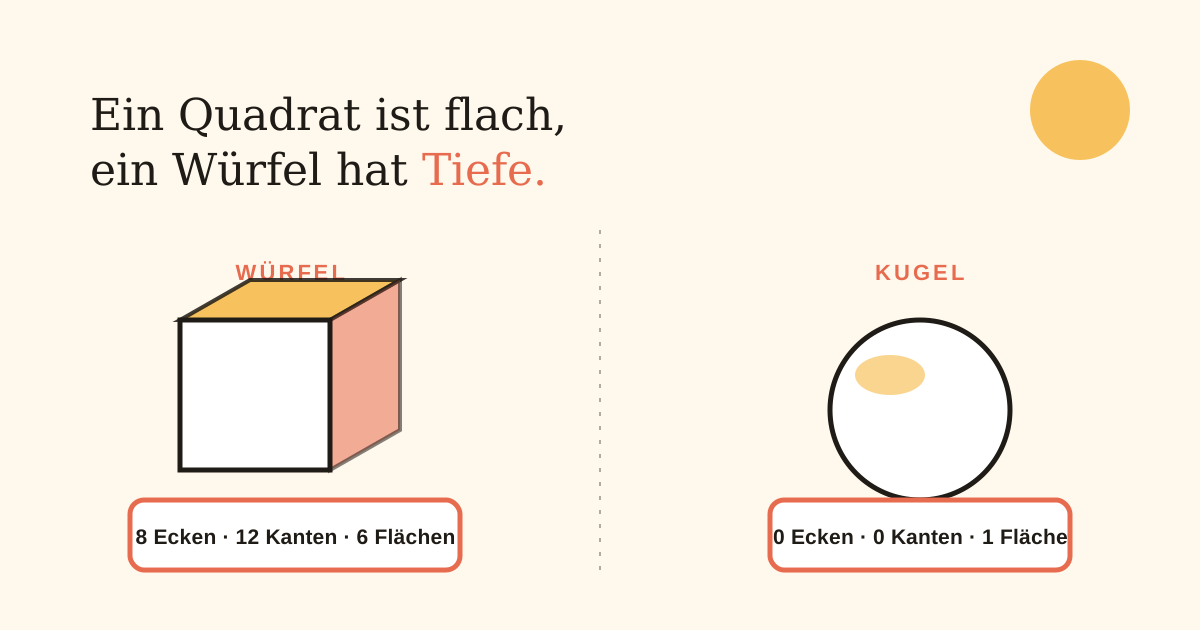
A square can be drawn on a sheet of paper; a cube can't — it needs room to go forward, not just up and sideways. After flat shapes like circles, triangles and quadrilaterals, years 3 and 4 bring the next step: 3D shapes, meaning shapes with depth. The jump is bigger than it looks, because suddenly what matters isn't just what a shape looks like, but also how many corners, edges and faces it has.
The six basic solids at a glance
Every basic solid has a fixed number of corners, edges and faces — that's exactly what makes it identifiable, no matter its size or the angle it's drawn from.
- Cube: 6 equal square faces, 8 corners, 12 edges — a classic dice.
- Cuboid: 6 rectangular faces, 8 corners, 12 edges — a shoebox or a book.
- Sphere: no corners, no edges, a single curved surface — a ball.
- Cylinder: two round faces top and bottom with a curved side between them, no corners — a tin can.
- Cone: one round face and a point, with a curved side between them — an ice cream cone.
- Pyramid: a flat base and triangular faces that meet at a single point — like the Pyramids of Giza.
Where the mistake comes from
Most mistakes don't come from recognising a solid in real life, but from translating it into the right term and from counting on a flat drawing of it.
- Squares and cubes get mixed up — a drawing showing only two sides of a cube gets counted as having 4 corners instead of 8, because the hidden back corners are missed.
- Circles and spheres get treated as the same — a sphere gets described as "one round face", when it actually has no flat face at all, only a single curved surface.
- Cylinders and cones get swapped, because both have a round base — the difference is the point: a cone narrows to a tip, a cylinder stays the same width top and bottom.
- When counting edges, a hidden edge on the drawing gets missed, or a visible edge gets accidentally counted twice.
What your child can already build on
A child who already reliably tells squares and rectangles apart among flat shapes has done the key groundwork for cubes and cuboids: a cube is made entirely of square faces, a cuboid of rectangular ones. What's new isn't the individual face, but that several of them together form a shape with depth.
Confident counting helps directly too — systematically counting the corners, edges and faces of a solid is the same skill already practised counting objects in rows and groups, just now applied to a three-dimensional object instead of a flat row.
How to practise this at home in 10 minutes
A few drills that need no worksheet:
- Collect objects around the house — a dice, a tin can, a ball, an ice cream cone, a book — and match each one to its correct term.
- Count the corners, edges and faces of a dice together, touching each one with a finger while counting: 8 corners, 12 edges, 6 faces.
- Cut out and fold a paper net for a cube — this makes visible how six flat squares become a shape with depth.
- Sort packaging on your next shopping trip: which is a cuboid, which is a cylinder — a cereal box against a tin can.
What Talentists does differently
Our grade 3–4 worksheets introduce every basic solid through a real everyday object first, before the drawing on paper, and practise counting corners, edges and faces directly on the object, not only on the diagram.