Centimetres and metres, grams and kilograms, millilitres and litres, cents and euros — your child already knows these units from everyday life and has practised each on its own: measuring length, estimating weight, measuring volume, working with money. What's new now is switching between the units of the same quantity — converting 3 m to cm, 250 g to kg, 1.5 l to ml. That's not a new quantity, it's a new skill: knowing the right conversion factor and calculating in the right direction.
The rule in one sentence
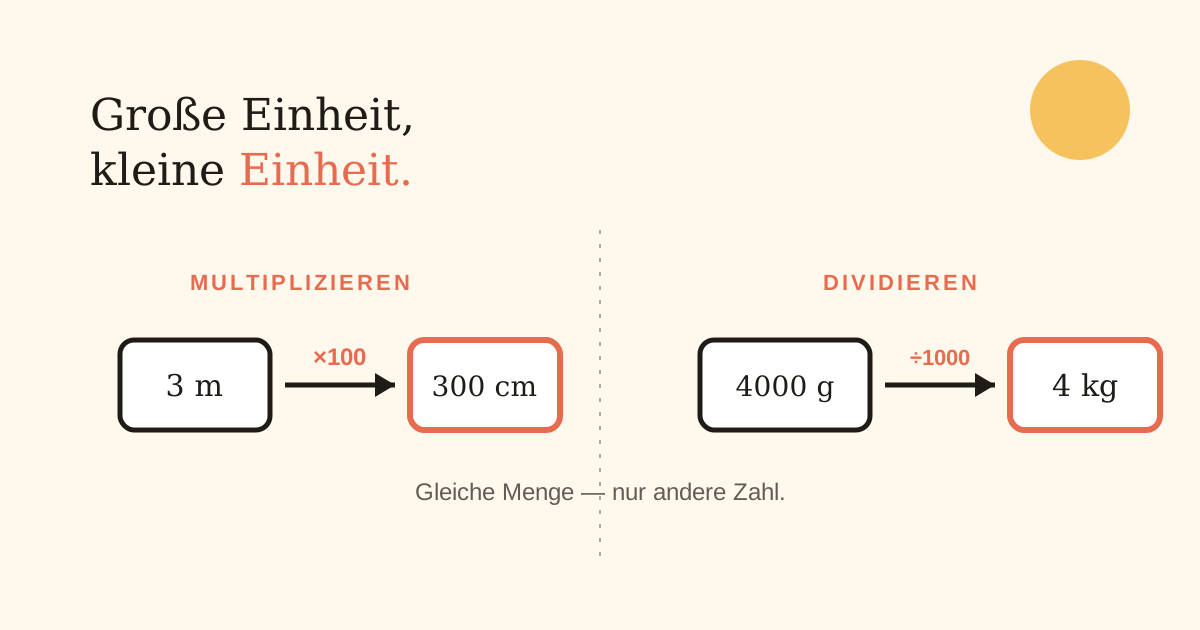
Converting from a large unit to a small one means multiplying — by the same factor the small unit is smaller by. Converting from a small unit to a large one means dividing by that same factor.
The key factors for primary-school age: 1 m = 100 cm, 1 km = 1000 m, 1 kg = 1000 g, 1 l = 1000 ml, 1 euro = 100 cents. So 3 m becomes 3 × 100 = 300 cm, and 4000 g becomes 4000 ÷ 1000 = 4 kg.
Where the mistake comes from
The conversion itself is plain mental math with 10, 100 or 1000 — the mistakes almost always happen before that, in spotting the factor and the direction.
- The direction gets swapped — converting m to cm by dividing instead of multiplying, so 3 m suddenly becomes 0.03 cm, a tiny number for a length that hasn't actually changed.
- The wrong factor gets used — m and cm get converted with 10 instead of 100, because the factor gets mixed up with a different unit pairing (10 is the factor for cm and mm, for instance).
- When converting with a decimal point, the shift gets memorised without understanding the zeros behind it and applied by the wrong number of places — 2.5 m becomes 25 cm instead of 250 cm.
- Mixed-unit amounts get added without first converting to a shared unit — 3 m 20 cm + 45 cm gets worked out as 3 m 65 cm, without adding the 20 cm and the 45 cm together first.
What your child can already build on
Converting units doesn't need new knowledge — just the connection of two skills already practised: a solid feel for each individual unit from measuring, weighing and working with money, and mental math with 10, 100 and 1000, already familiar from place value. A child who knows that multiplying by 100 shifts a number two places to the left applies that same knowledge directly to metres and centimetres.
Working with money is a hidden advantage too: 1 euro = 100 cents is structurally the same conversion as 1 m = 100 cm — just in a familiar context many children already feel confident in.
How to practise this at home in 10 minutes
A few drills that need no worksheet:
- Measure things around the house with a tape measure in cm, then state the result in m and cm together — a 154 cm door frame becomes 1 m 54 cm.
- While shopping, read out package labels and convert them: how many grams is a half-kilo bag of flour? How many millilitres is 1.5 litres of juice?
- Read through a recipe together and convert the ingredients from grams to kilograms or from millilitres to litres before shopping for them.
- A conversion card game: one card shows an amount in one unit (e.g. 2.3 kg), and your child has to find the matching card in the other unit (2300 g).
What Talentists does differently
Our grade 3–4 worksheets practise each unit pairing on its own with everyday objects first, before mixed exercises with several conversions in one problem. A five-minute assessment shows whether your child already reliably tells multiplying and dividing apart when it comes to the direction of the conversion, and the worksheets start exactly there.