Half a cake, two quarter-slices, four eighth-slices — all three fractions describe exactly the same amount of cake, only the number of pieces differs. A child who's already discovered this equivalence by folding and comparing fractions already knows the result. What's new now is the calculation route to get there: how do you systematically find an equivalent fraction for a given one, without folding paper every single time? That's exactly what simplifying and expanding do — two operations that mirror each other.
The rule in one sentence
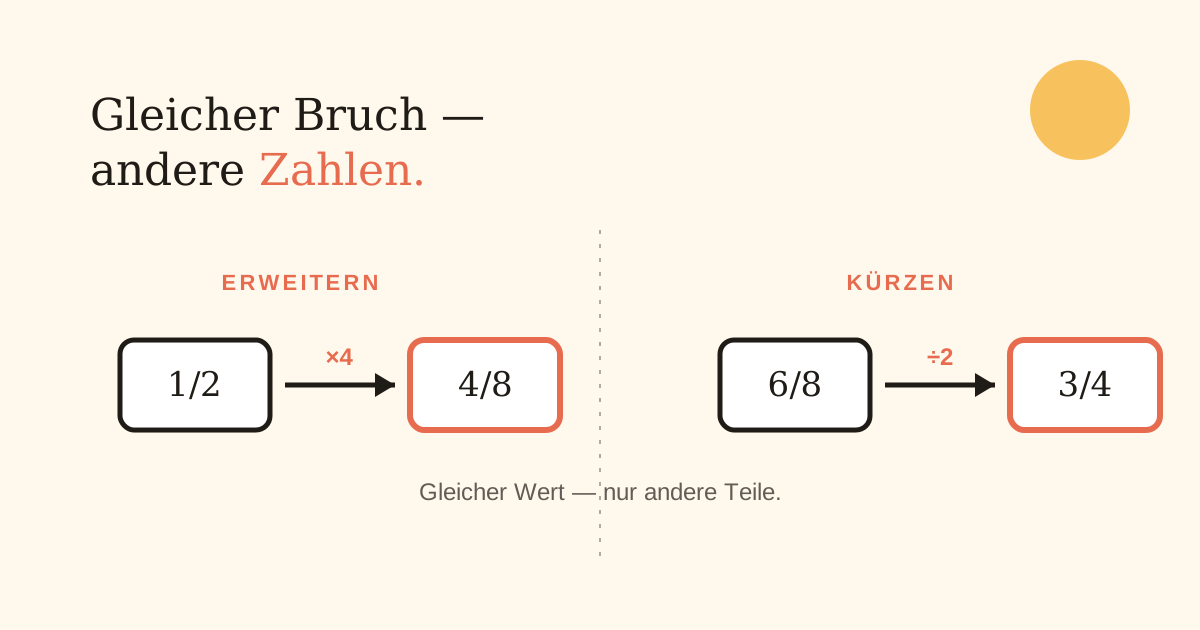
Expanding means the numerator and denominator are multiplied by the same number. Simplifying means the numerator and denominator are divided by the same number. Either way, the value of the fraction never changes — only the number of pieces the whole is split into.
One example for each direction: 1/2 expanded by 4 becomes 4/8 — numerator and denominator each times 4. The other way round, 6/8 simplified by 2 becomes 3/4 — numerator and denominator each divided by 2.
Where the mistake comes from
Almost every mistake with simplifying and expanding happens because one of the two numbers in the fraction gets changed on its own instead of both together.
- Only the numerator or only the denominator gets changed — 1/2 accidentally becomes 2/2 instead of 2/4, because the second number is forgotten.
- Numerator and denominator get added to instead of multiplied — 1/2 turns into 4/5 by adding 3 to each number, instead of 3/6 by multiplying by 3, a mistake that never comes up with whole numbers because there's only one number there.
- When simplifying, the division is by a number that doesn't divide both numbers evenly — 5/9, for instance, can't be simplified at all, because 5 and 9 share no common factor other than 1.
- A fraction only gets simplified once, even though it could go further — 8/12 gets simplified to 4/6 and left there, even though 4/6 can be simplified again to 2/3.
What your child can already build on
Simplifying and expanding don't need a new concept, just the connection of two familiar things: the picture of equivalent fractions from folding and comparing, and confident recall of the times tables. A child who knows that 4 times 3 is 12 spots the same relationship in 3/4 and 9/12 instantly — once written as a multiplication fact, once as a fraction.
For simplifying, knowledge of divisibility helps too: a child who has already practised whether a number divides by 2, by 3 or by 5 finds the right number to divide both parts of a fraction by more quickly.
How to practise this at home in 10 minutes
A few drills that need no worksheet:
- Fold a paper strip twice — once into halves, once into quarters, once into eighths — and write the matching fraction at each fold line. This makes the chain 1/2 = 2/4 = 4/8 visible.
- Use a 12-egg carton as a visual aid: 6 filled slots are 6/12, but also 1/2 — half the carton. What number can 6/12 be simplified by, to leave as few slots as possible in the fraction?
- Play a memory game with hand-written cards: write equivalent fractions like 1/3, 2/6 and 4/12 on separate cards and have your child match them when flipped over.
- For every pair found, say the calculation out loud: "1/3 times 2 on top and on the bottom gives 2/6" — saying it this way every time stops only one of the two numbers from being changed.
What Talentists does differently
Our grade 3–4 worksheets introduce simplifying and expanding through the same folded-picture models already used to introduce fractions — not a new approach, just the next step. Egg-carton and strip exercises come before the bare calculation, so your child sees what they're calculating before changing numbers without a picture.