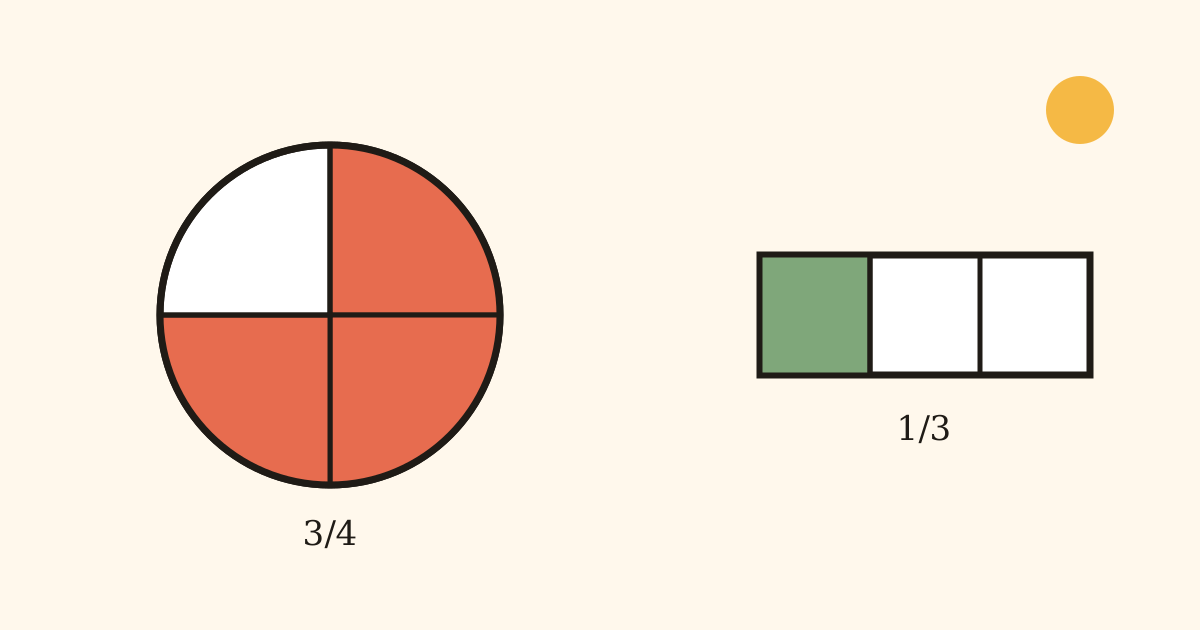
Up to this point, a number was always one number: 7, 23, 100. Fractions change that for the first time — a number like ¾ is suddenly made of two numbers stacked together, and both change what's meant at once. No wonder the introduction to fractions confuses many children: some of what held true about numbers so far now needs rethinking.
The good news: fractions can be built almost entirely from hands-on experience, with not a single calculation rule needed at the start. A child who understands a fraction as a picture has already done half the work.
A fraction as part of a whole
The simplest way in is folding and cutting, not computing. A pizza, a sheet of paper, a chocolate bar — anything that splits into equal pieces. Split the whole into four equal parts and let your child take three of them, and they have exactly ¾ — three quarters.
The two numbers in a fraction have clearly separate jobs: the bottom number, the denominator, says into how many equal parts the whole was split. The top number, the numerator, says how many of those parts are meant. When practising, say it out loud in full — "split into four parts, three of them taken" — instead of just saying "three quarters". The long sentence makes visible what the short notation hides.
The mix-up that shows up almost every time
With whole numbers, bigger means more. With fractions, that flips for the denominator — an eighth is smaller than a quarter, even though 8 is bigger than 4. For a child who's just learned that 8 is more than 4, that feels like a contradiction.
The hands-on fix: break the same chocolate bar twice, once into four pieces and once into eight, and lay the pieces side by side. An eighth-piece is visibly smaller. The more pieces made from the same whole, the smaller each individual piece gets — that doesn't need to be memorised once it's been seen.
Equivalent fractions: the same part, different numbers
A second aha moment: ½ and 2/4 look different but mean the same part of the whole. Again this is better folded than calculated: fold a sheet of paper in half once and colour one half — that's ½. Fold the same sheet again the other way — now 2 of 4 equal-sized panels are coloured, i.e. 2/4. The coloured area didn't change on the second fold, only the number of pieces.
This exercise matters more than it looks: the concept of "equivalent fractions" underlies almost everything that comes later in fraction work — comparing, adding, simplifying fractions. A child who has folded and seen it once won't need to memorise it afterwards.
Three exercises for home
Fractions need one thing above all: real occasions where a whole actually gets split into parts, not just drawn on paper.
- The snack split: share an apple or a slice of bread between the children in the family — count out loud how many parts it's split into and how many each child gets.
- The measuring-cup check: while baking, the ¼, ½ and ¾ marks on a measuring cup show fractions in daily life — and how many quarter-fills add up to a whole.
- The fold book: fold several equal strips of paper — one into halves, one into quarters, one into eighths — and lay the strips on top of each other. That makes it visible at a glance which fractions are the same size.
Fractions are the first moment in primary-school math where a child has to expand their existing understanding of number rather than simply apply it. Investing time in hands-on experience rather than rules here makes the rest of the road through fractions considerably easier.