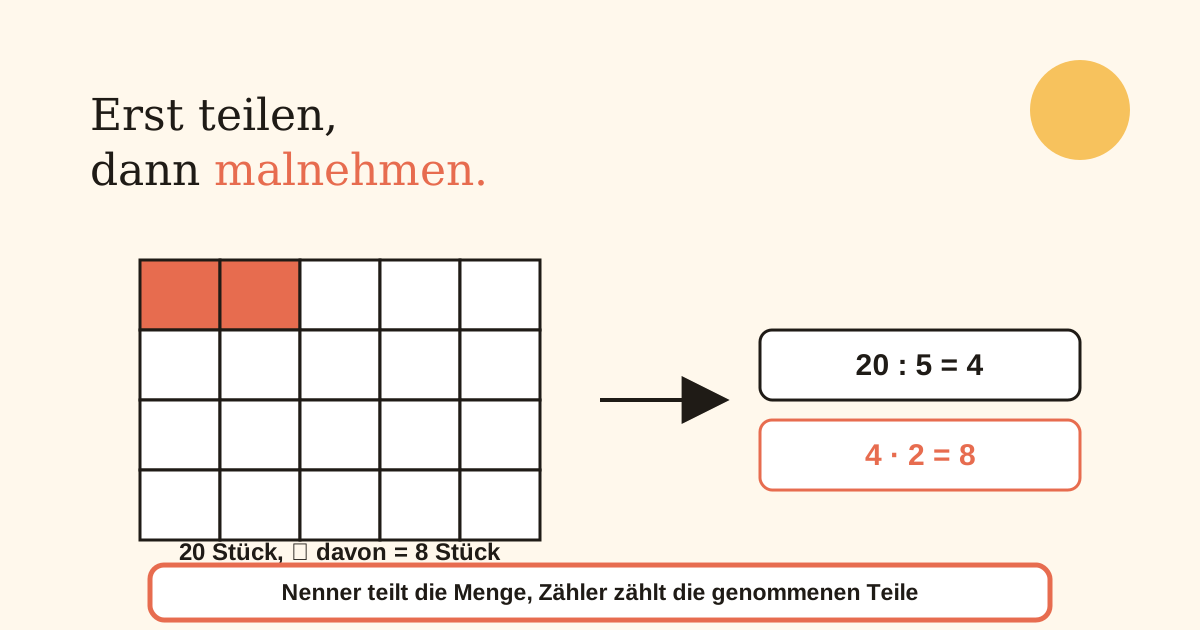
A fraction that only lives on paper stays abstract. The moment it meets a real quantity — ¾ of 60 minutes, ⅓ of a class of 24 children, ⅖ of a chocolate bar with 20 pieces — the fraction suddenly turns into a concrete calculation with a tangible answer. That step, from fraction-as-picture to fraction-as-instruction, is exactly the next one your child takes after learning to understand and compare fractions.
The good news: the calculation behind it isn't a new skill. It's exactly two steps your child already knows from division and the times tables — just in a new order.
What a fraction of a quantity means
¾ of 60 minutes means: the 60 minutes are first split into 4 equal parts — that's what the denominator says. Then 3 of those parts are taken — that's what the numerator says. The denominator and numerator still do exactly the same job as when a fraction was just a picture, except now a real number is being divided and added back up instead of a shape being coloured in.
The calculation in two steps
Step 1 — divide by the denominator: 60 minutes divided by 4 (the denominator) is 15 minutes. That's the value of ONE of the four parts. Step 2 — multiply by the numerator: 15 minutes times 3 (the numerator) is 45 minutes. That's the fraction being asked for. ¾ of 60 minutes is 45 minutes.
A second example to cement it: ⅖ of 20 pieces of chocolate. Step 1: 20 divided by 5 (denominator) is 4 pieces per fifth. Step 2: 4 times 2 (numerator) is 8 pieces. ⅖ of 20 pieces is 8 pieces.
The most common mistake
The mistake almost always happens in step one: dividing by the numerator instead of the denominator. For ¾ of 60, that means accidentally dividing by 3 instead of 4 — an answer that looks plausible but is wrong. The memory hook: the denominator sits at the bottom and splits the quantity into its parts; the numerator sits at the top and counts how many of those parts are taken.
What your child can already build on
A child who divides confidently and can recall the times tables already holds both tools needed for this calculation — all that's added here is the order in which the two are used, one after the other. And a child who already knows the denominator names the number of parts and the numerator names how many are taken just needs to learn that a real calculation now sits behind that description.
How to practise this at home in 10 minutes
A few drills that need no worksheet:
- Split a real chocolate bar with 20 pieces (or a pack of biscuits): how much is ⅖ of it? Calculate first, then count to check.
- Grab a clock and ask: how many minutes are ¾ of an hour? And how many minutes are ¼ of an hour?
- Gather a group of 12 building blocks or 24 crayons and ask for different fractions of it: ⅓, ½, ⅔.
- While baking, work out a fraction of an ingredient amount together, such as ¾ of 200 grams of flour.
What Talentists does differently
Our worksheets always have your child work out a fraction of a quantity in the two separate steps — divide, then multiply — instead of demanding a shortcut formula by heart, so they can always explain why the calculation works, not just that it does.