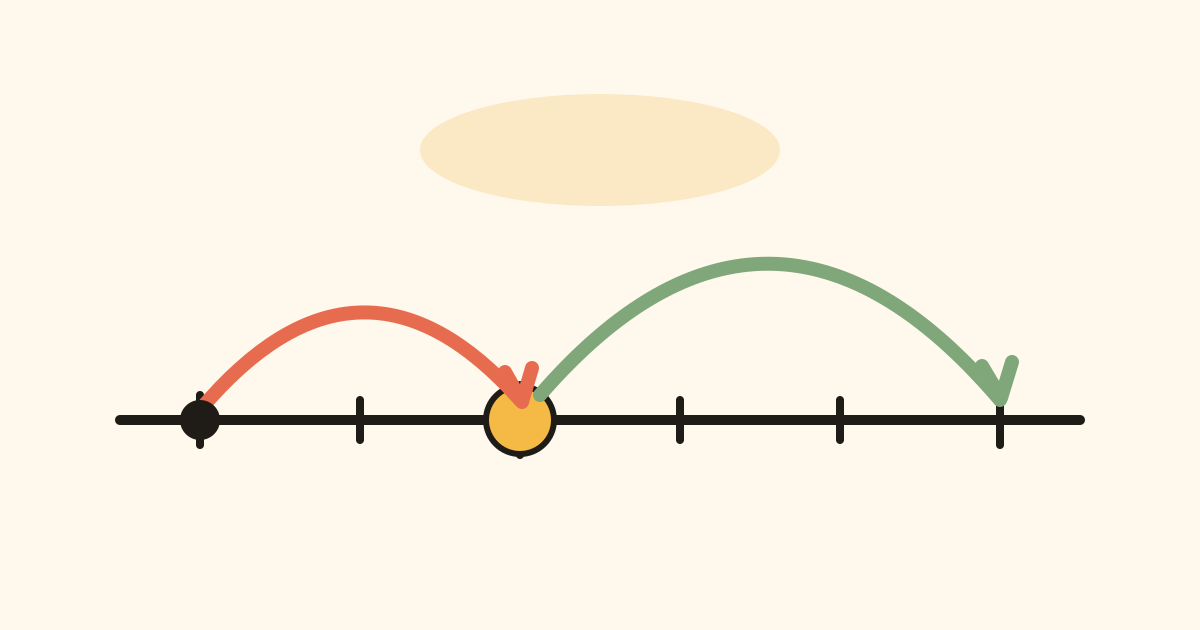
Ask a second-grader 32 + 25 and the answer usually comes quickly. Ask 37 + 25 and it goes quiet. The difference between the two problems is exactly one thing: the tens boundary. In 37 + 25 the ones don't fit — 7 + 5 spills over into a new ten, and that moment is the biggest conceptual hurdle of grade 2.
The good news: crossing ten isn't about talent, it's about the right intermediate steps. A child who can walk it in steps owns the whole number range.
Addition across ten: to the ten first, then onward
The strategy almost all schools introduce first is stepwise computing across the ten. Played out on 37 + 25: first your child fills up to the next ten — 37 + 3 = 40. Then the rest — 22 of the 25 remain, so 40 + 22 = 62.
The trick when explaining: let your child choose the first step themselves. “How far is it from 37 to the next round number?” Filling to the ten is the core move — once that's solid, the rest is routine. An empty number line on paper (a simple line with hops: +3, then +22) makes the steps visible and stays in the head as a picture.
Subtraction across ten: taking away in steps
For 62 − 27 the same logic runs backwards: first subtract to the ten — 62 − 2 = 60. Then the rest — 25 of the 27 remain, so 60 − 25 = 35.
A note for parents who learned differently themselves: most German states today teach decomposition (taking away) as the standard — not the “adding up” method (“from 7 to 12 is 5”) many of us remember from school. Both are mathematically correct. But: stick to the method your child brings home from school. Two competing procedures in a head that's just building its first one create more confusion than benefit. When in doubt, a glance into the school exercise book shows which path is being taught.
The most common mistake — and what it means
If 62 − 27 comes out as 45, that's not a careless slip — it's a very informative one: your child treated the digits column by column and computed “7 minus 2” in the ones, because “2 minus 7 doesn't work”. It shows the number is still seen as two separate digits, not as one quantity.
The response isn't more rules but more concrete imagery: back to the number line, back to “how far to the ten?”, if needed back to counters or Lego bricks bundled in tens. Understanding repairs this mistake — repetition alone cements it.
Practise in three stages
If crossing ten wobbles, this order helps:
- Stage 1 — secure the bonds of 10: all pairs that make 10 (7+3, 6+4, 8+2 …) must be instant. They're the tool for everything else.
- Stage 2 — crossing with a number line: solve problems like 37 + 25 with drawn hops. The picture carries the understanding.
- Stage 3 — bare problems: only when stage 2 runs fluently come problems without the visual aid. Speed explicitly doesn't matter here — it arrives on its own.
Crossing ten is the milestone of grade 2. It's worth investing time here even if other topics have to wait — every later kind of arithmetic builds on exactly this move.