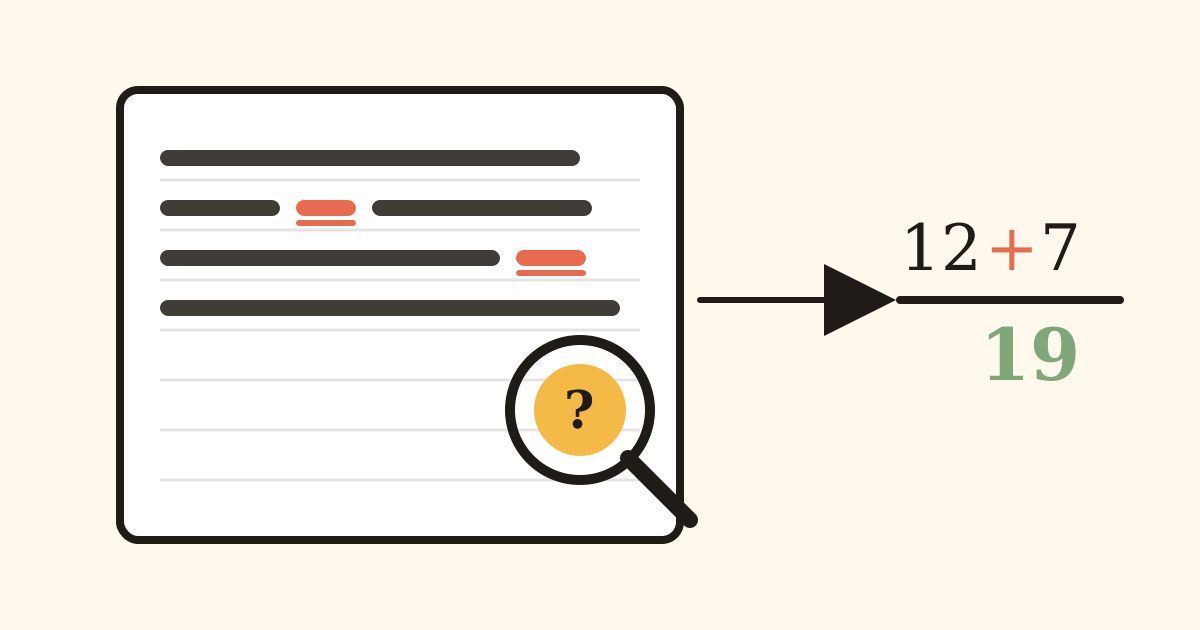
A familiar scene: your child solves 12 + 7 without thinking, but freezes in front of “Lena has 12 stickers. Her grandpa gives her 7 more. How many does she have now?” Same numbers. Same arithmetic. And yet the second version is far harder for many children.
That's not a contradiction — it's a clue about which skill is actually being tested. A word problem demands two entirely different steps in sequence: first understand a text and translate it into an equation, then solve that equation. When a child struggles with a word problem, the first step is almost always the problem — not the second.
What's actually the sticking point
To turn “Lena has 12 stickers, gets 7 more” into “12 + 7”, your child has to do several things at once: pull the relevant numbers out of the text, understand the described action (getting more → the amount grows), ignore irrelevant details (grandpa doesn't matter, neither does the occasion), and choose the right operation from that.
That's a reading-comprehension skill wearing a math costume, not a math problem with some text wrapped around it. Which is exactly why “just practise more arithmetic” doesn't help much here — that trains the second step, while the first is the real hurdle.
The four-step method
This fixed order takes the fear out of word problems by breaking the problem into manageable pieces:
- 1. Circle the question: first circle the final question in the text. “How many does she have now?” — that's the goal; everything else only exists to get you there.
- 2. Underline the numbers: underline every number in the text and jot down what it stands for. “12 = stickers at the start”, “7 = received”.
- 3. Draw or act out the action: a simple sketch or a few objects on the table showing what happens — does the amount grow or shrink? With “gets more”, the quantity grows — the picture shows that instantly, no operation sign needed yet.
- 4. Set up the equation and solve: only now does the operation sign come in — and the actual calculating is usually the easiest part at this point.
The trap of signal words
A common but treacherous tip: “more” means plus, “less” means minus. It often works — which is exactly why it's dangerous the moment it doesn't. In “Tom has 5 fewer stickers than Mia. Mia has 14. How many does Tom have?”, “fewer” does signal minus — correct! But in “How many more stickers does Tom need to have as many as Mia?”, the very same situation suddenly hides a plus.
Signal words are a shortcut, not a substitute for the action itself. If your child starts scanning problems only for keywords instead of understanding the situation, walk them back to step 3: what's actually happening here? Is something growing or shrinking, being combined or split apart?
A worked example, step by step
“8 children are playing tag in the schoolyard. 5 more children join. Then 4 children leave to get a drink. How many children are still playing tag?”
Step 1 — question: how many are still playing tag? Step 2 — numbers: 8 (start), 5 (joined), 4 (left). Step 3 — action: first more, then fewer — best shown with eight, then five added, then four crossed-out stick figures. Step 4 — equation: 8 + 5 − 4 = 9.
This problem has two operations and an intermediate value that's easy to miss if you dive straight into calculating. That's exactly why the order matters: understand first, calculate second — never the other way round.
Word problems aren't an extra difficulty layer bolted onto arithmetic — they're the moment math first meets the real world. The effort your child invests here pays off well beyond primary school. That's why our practice worksheets deliberately include word problems built with exactly this structure, and a QR code leads, if needed, to an explanation that walks through all four steps instead of just revealing the answer.