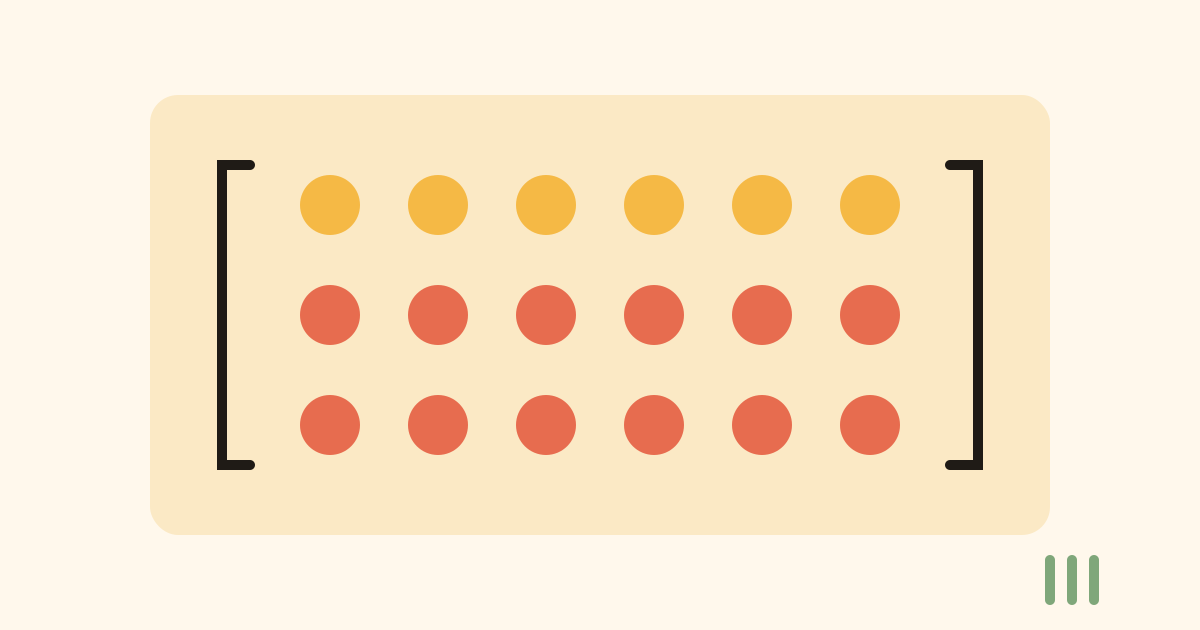
Times tables are the first topic where many families notice: understanding alone isn't enough. Your child can explain what 4 × 6 means — and still needs twenty seconds to answer. That's not a deficit, it's a stage. Between “I can work it out” and “I just know it” lies practice. A very specific kind of practice.
The good news: it doesn't take long study afternoons. Ten minutes a day, split cleverly, beats any two-hour Sunday session. The reason is the spacing effect: memory consolidates best when repetitions are spread across days rather than crammed into one sitting. Short and often beats long and rare.
The plan: 2 + 5 + 3 minutes
Here's what the ten minutes look like. They work at the kitchen table, with pencil and paper, no app and no preparation:
- 2 minutes review: five problems from yesterday's table. Spoken or written — what matters is that your child recalls rather than recalculates.
- 5 minutes new table: one table only, in small steps. First recite in order (2, 4, 6, 8 …), then quiz out of order, then have them write five problems down.
- 3 minutes mixed round: problems from every table learned so far, shuffled. This is the part that makes the long-term difference.
The right order of tables
Not all tables are equally hard, and the textbook order isn't always the friendliest for learning. What works: start with the 2s, 10s and 5s. All three have strong patterns (doubling, appending a zero, final digit 0 or 5) that give your child quick wins.
Then the 4s — they're double the 2s, which you can show beautifully: 4 × 6 is twice 2 × 6. After that the 8s as double the 4s. Then 3s, 6s and 9s. The 7s come last — they have the weakest pattern and benefit most from every other table already being solid. By then your child barely needs to “learn” 7 × 8 at all: they already know it as 8 × 7.
Two tricks that halve the workload
Swap pairs: 3 × 8 and 8 × 3 give the same result. A child who grasps this early only has to truly learn about half of all facts. Say it explicitly and let them hunt for pairs — it feels like a secret trick and is mathematically watertight.
Anchor facts: the ×5 and ×10 problems of every table are landmarks. Almost everything can be derived from there: 6 × 7 is 5 × 7 plus one more 7. That's not a crutch — it's exactly the flexibility needed later for bigger multiplication and mental strategies.
How you know a table is solid
The simplest yardstick is response time. If the answer comes in about three seconds, without lips silently counting along, the fact has reached long-term memory. If it takes longer, your child is still computing — which is fine, but means: keep practising, don't tick it off yet.
A word on well-meant pressure: stopwatches and races create exactly the tension that blocks recall in many children. Observe the pace quietly, but don't turn it into a competition. Accuracy first, speed follows on its own.
Ten minutes a day, four to six weeks, and the times tables stand. Writing on paper consolidates them better than typing — the pencil isn't a nostalgia accessory in learning, it's a tool.